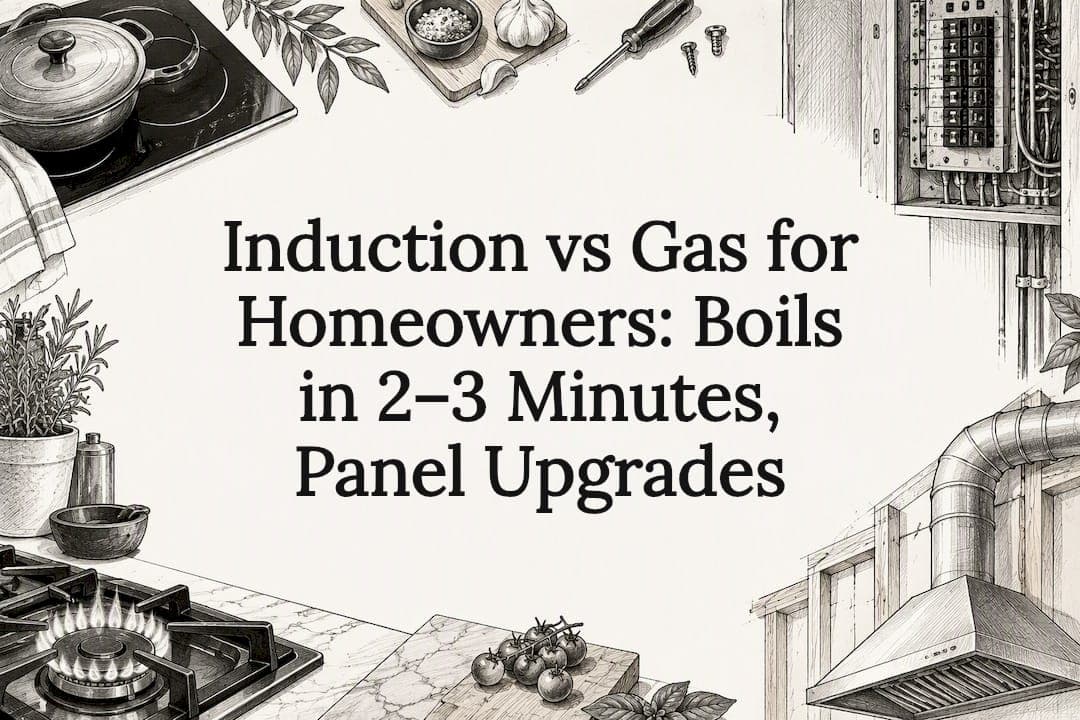
For most households, induction provides faster cooking, higher energy efficiency and fewer in-use combustion pollutants than gas. Gas still holds appeal for cooks who want visible flame control and no reliance on electrical upgrades. Before deciding, weigh three trade-offs: upfront cost and electrical work, cookware compatibility, and ventilation needs, the same factors Natural Resources Canada and Health Canada point to, and the ones we see most often in kitchen renovations.
TL;DR:
- Induction ranges often require a dedicated 40 to 50 amp circuit, and older homes may need a panel upgrade, so confirm capacity and costs first.
- Test pans with a magnet before replacing cookware; cast iron and most stainless steel work, but pure aluminum, copper, glass, and ceramic usually fail.
- A 2025 pooled analysis linked gas stove use to winter indoor NO2 increases of 191% and peak hourly carbon monoxide increases of 43%.
- Health Canada says a properly sized ducted hood can cut cooking pollutant exposure by more than 80%; recirculating models do little to remove NO2.
- Choose gas if your cooking relies on direct flame for wok movement or charring, or if outages matter and your gas range supports manual ignition.
Table of Contents
- Performance: speed, temperature control and cooking outcomes
- Health and safety: indoor pollutants and burn risks
- Energy efficiency, operating costs and installation trade-offs
- Which pots and pans work and how to test them
- Daily use: cleaning, controls and accessibility
- How to reduce pollutant exposure with either cooktop
- Renovation and installation considerations: when to call a contractor
- Decision checklist and next steps
- From the contractor: what homeowners typically miss
- Another option: Y&CO Build can handle electrical and layout work
- FAQ
- Sources
Performance: speed, temperature control and cooking outcomes
Induction wins on raw speed. A typical induction cooktop can bring a pot of water to a boil in about 120 to 180 seconds, because the coil heats the pan's base directly instead of warming the air and cookware surface the way a gas flame does. That directness also means faster response when you turn the dial down, which matters more than it sounds for everyday cooking.
In practice, the difference shows up in a few common situations:
- Boiling pasta water or blanching vegetables happens noticeably quicker on induction.
- Simmering sauces is easier to hold steady on induction, since the element reacts almost instantly to a dial change.
- Stir-frying rewards gas cooks who like to lift the pan off the heat and back on, a motion that does not register the same way on a flat induction surface.
- High-heat searing is excellent on both, though induction often reaches searing temperature faster.
Gas still has an edge in a few edge cases: cooking with a wok that needs to rock in and out of direct flame, recipes that call for charring something directly over an open burner, or kitchens where cooks have spent years building muscle memory around flame height as a visual cue. For most daily cooking tasks, though, induction's speed and tighter heat control outperform gas.
Health and safety: indoor pollutants and burn risks
The clearest health argument for induction comes down to combustion. Burning gas indoors releases nitrogen dioxide and carbon monoxide, and a 2025 pooled analysis found gas stove use was linked to a 191% increase in indoor NO2 concentrations in winter and a 43% increase in peak hourly carbon monoxide levels in winter.
A separate laboratory study measured far higher ultrafine particle counts and NOx from gas cooking compared with induction when hoods were off, and found induction produced no discernible NOx in the same tests.
Beyond air quality, there are physical safety differences:
- Gas burners carry an open flame and hot grates, a real burn and fire risk around loose sleeves or curious kids.
- Induction surfaces stay relatively cool except directly under the pan, since the cooktop itself is not the heat source.
- Gas burners need periodic cleaning of grates, igniters and burner caps to keep flames even.
- Induction's flat glass surface has no crevices for grease or food to collect.
Induction does not eliminate pollutants from cooking itself, since any frying or searing still produces particulate matter, so ventilation remains part of the picture either way.
Energy efficiency, operating costs and installation trade-offs
Induction converts far more of its energy into actual cooking heat. One evaluation of an induction adoption program estimated induction efficiency at roughly 85 to 90%, compared with 35 to 50% for gas, largely because gas loses heat to the surrounding air instead of transferring it directly into the pan. The same review noted that switching from gas to induction is more likely to cut greenhouse gas emissions where the local electricity grid is low-carbon, so the climate benefit depends partly on how your power is generated.
On the electric side, induction cooktops use about 15 to 20% less electricity than traditional resistance plates, which adds up over years of daily cooking.
The installation side is where induction asks more of you upfront:
- Induction ranges often need a 40 to 50 amp dedicated circuit, and older homes may require a panel upgrade to supply it.
- Gas ranges need an existing gas line, which is simple if one is already in place but costly to add if not.
- Budget for the appliance itself, any electrical work, and ducting if you are upgrading your range hood at the same time.
If your panel is older or near capacity, it is worth checking what a rewire or upgrade typically costs before committing to a induction range.
Which pots and pans work and how to test them
Induction only heats cookware that is ferromagnetic, meaning the pan's base has to respond to a magnetic field for the coil to transfer heat into it. Natural Resources Canada notes this is the main compatibility hurdle when switching from gas.
- Hold a refrigerator magnet to the bottom of your pan. If it grips firmly, the pan will work on induction.
- Cast iron, enamelled cast iron and most stainless steel pans pass the test, along with multi-clad pans that have a bonded steel base, a detail All-Clad's own compatibility guide confirms.
- Pure aluminum, copper and most glass or ceramic cookware will not work unless the base includes a steel layer.
- If most of your set fails the test, start by replacing your two or three most-used pans rather than the whole collection.
Daily use: cleaning, controls and accessibility
Induction's flat glass top wipes clean in seconds, since there are no grates, burner caps or igniters to disassemble. Gas burners need more regular attention to keep flames burning evenly and to clear spills from around the igniter.
Controls differ in feel more than function:
- Induction typically offers digital presets, timers and child locks built into the touch panel.
- Gas gives you a dial and a visible flame, which some cooks still prefer as direct feedback.
- Induction requires electricity to operate, so a power outage means no cooktop at all.
- Gas ranges with a standing pilot or manual ignition can sometimes still be lit during an outage.
Pro Tip: If outages are a real concern where you live, ask your installer about a battery backup or generator transfer switch rather than ruling out induction entirely.
How to reduce pollutant exposure with either cooktop
Ventilation matters no matter which cooktop you choose, since cooking itself produces particulates. Health Canada recommends a ducted range hood run on high while cooking, noting that a properly sized hood can reduce exposure to cooking-related pollutants by more than 80%.
- Choose a hood that vents outdoors rather than one that recirculates air back into the kitchen.
- Run the hood on its highest setting during cooking and for a few minutes after.
- Use back burners when possible, since they sit closer to the hood's capture zone.
- Crack a window for extra airflow when cooking something that produces heavy smoke or steam.
Recirculating hoods filter grease but do little for gases like NO2, so a ducted model is the better long-term choice.
Renovation and installation considerations: when to call a contractor
Switching to induction sometimes means more than swapping an appliance. A panel upgrade, a new dedicated circuit, or hood ducting routed through a ceiling or exterior wall all call for licensed trades working in sequence, especially during a larger kitchen layout change. Coordinating an electrician, an HVAC installer and an appliance delivery around one schedule is exactly the kind of work a single point of contact is built to manage.

Decision checklist and next steps
Three questions settle most of the debate: do you prioritize indoor air quality and efficiency, do you have the electrical capacity for induction, and do you need true flame cooking for your style of cooking?
- Run the magnet test on your current cookware before you buy anything.
- Call an electrician to confirm your panel can support a dedicated induction circuit.
- Choose a ducted hood sized for your cooktop, not a recirculating one.
- Book a consult if your kitchen needs layout or electrical changes to make the switch.
From the contractor: what homeowners typically miss
Homeowners usually underbudget two things: electrical upgrades and hood ducting, plus appliance lead times that can stretch a schedule by weeks. A single accountable builder managing electricians, HVAC and appliance delivery together avoids the back-and-forth that usually causes delays.
— Cory
Another option: Y&CO Build can handle electrical and layout work
If a panel upgrade, new circuit or hood ducting stands between you and an induction range, that work fits naturally into a broader kitchen renovation. We handle feasibility review, permitting, electrician and HVAC coordination, and layout changes as part of our full-home renovations in Toronto, with Cory as your single point of contact from the first walkthrough to the final inspection.
If your kitchen needs more than a new appliance to make induction work, a feasibility consult is the place to start.
FAQ
What is the difference between convection and induction cooking?
Convection refers to an oven that circulates hot air with a fan for more even baking, while induction refers to a cooktop that heats pans directly through electromagnetic current. They solve different problems and often appear together in the same range.
Is induction cooking safe?
Induction cooktops do not burn fuel, so they produce no combustion byproducts like NO2 or CO during use, and the surface itself stays cooler than a gas flame. The main safety consideration is ferromagnetic cookware compatibility rather than burn or air quality risk.
Is gas faster than induction?
No, induction is generally faster: it can bring water to a boil in about 120 to 180 seconds, because the coil heats the pan directly rather than warming the surrounding air first. Gas still offers quick visual feedback when adjusting flame height, which some cooks prefer for certain techniques.
What is an induction cooktop?
An induction cooktop uses an electromagnetic coil beneath a glass surface to heat ferromagnetic cookware directly, rather than heating the air or surface the way gas or standard electric coils do. It requires pots and pans that respond to a magnet to work properly.
Sources
- Study linking gas stoves with higher indoor NO2 and CO concentrations (Canada-focused pooled analysis)
- Hydro‑Québec: induction range energy and performance guidance
- Factsheet: Cooking and indoor air quality — Health Canada
- Air pollutant exposure concentrations from cooking (LBL experimental study)
- Evaluation of an induction adoption program and its climate/health impacts