If your home already has well-sealed, correctly sized ducts, a ducted heat pump is usually the smarter buy. If it doesn't, or you've got a finicky room that's always too hot or too cold, a ductless mini-split solves that faster and with far less demolition. Either way, start with a Manual J load calculation and a duct inspection before you sign anything.
TL;DR:
- Existing duct condition heavily influences cost; leaky or damaged ducts require sealing or replacement, which can significantly raise the price of ducted systems.
- A single-zone ductless mini-split costs typically between $3,000 and $6,500, while multi-zone setups often range from $10,000 to $22,000, depending on zone count.
- Cold-weather performance is comparable for modern ducted and ductless systems when properly sized and matched, with units capable of functioning efficiently below minus 20 degrees Celsius.
- Ductless systems offer room-by-room control and easier installation, but indoor units are visible, and costs increase with each additional zone.
- Proper sizing through a Manual J load calculation and duct inspection is essential to ensure system efficiency and avoid underperformance over its lifespan.
Table of Contents
- Ducted vs ductless: what each system actually is
- Ducted vs ductless mini split: comparing the trade-offs
- What does ducted vs ductless actually cost?
- Which system performs better in cold weather?
- What does installation actually involve?
- How long do these systems last, and what breaks first?
- How do you choose between ducted and ductless?
- How HVAC decisions fit into a full renovation
- Where to verify the details
- Sources
- FAQ
Ducted vs ductless: what each system actually is
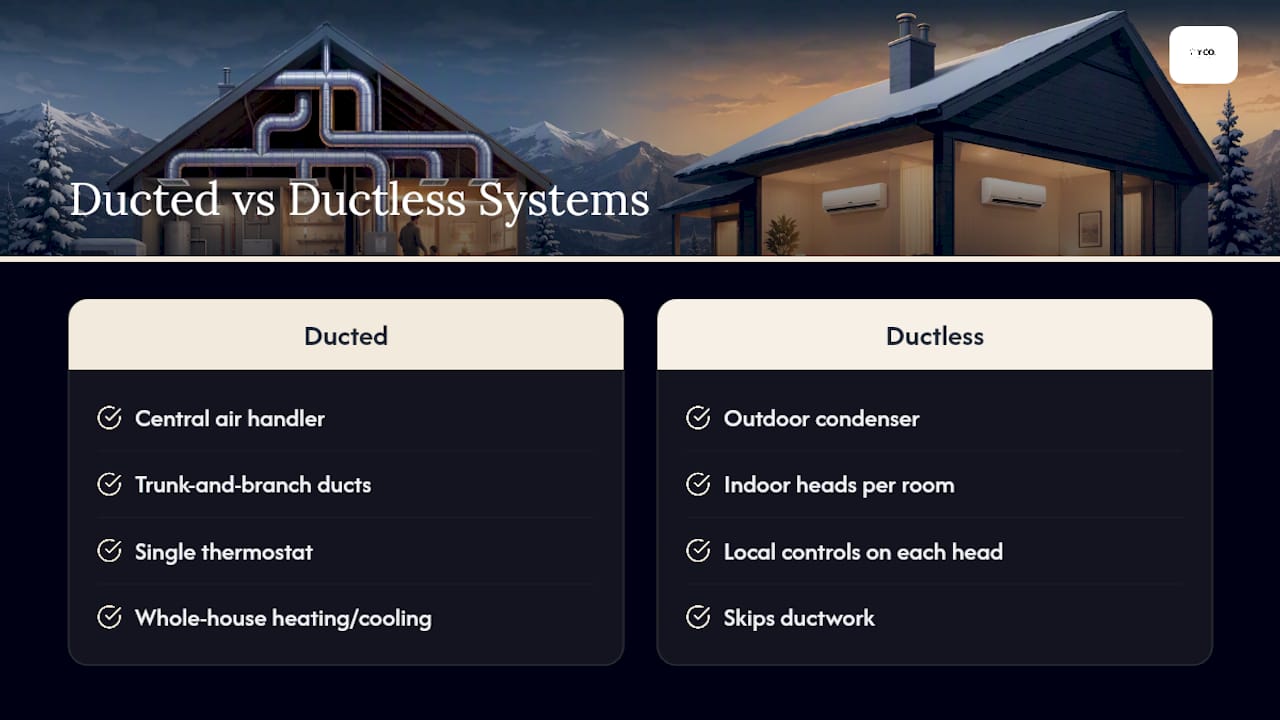
A ducted system runs a central air handler or air-source heat pump through trunk-and-branch ductwork to registers in every room, all controlled from one thermostat. It's the setup most North American homes already have, and it's built to heat or cool a whole house evenly from one piece of equipment.
Ductless HVAC systems, sometimes called mini-splits, skip the ductwork entirely. An outdoor condenser connects by refrigerant line to one or more indoor heads, each mounted in the room it serves, each with its own local control. New builds and homes with intact ducts tend to lean ducted; additions, basement conversions, and older houses that never had ducts installed usually lean ductless. As Lennox notes, the real decision comes down to how your home is built, not brand preference.
Ducted vs ductless mini split: comparing the trade-offs
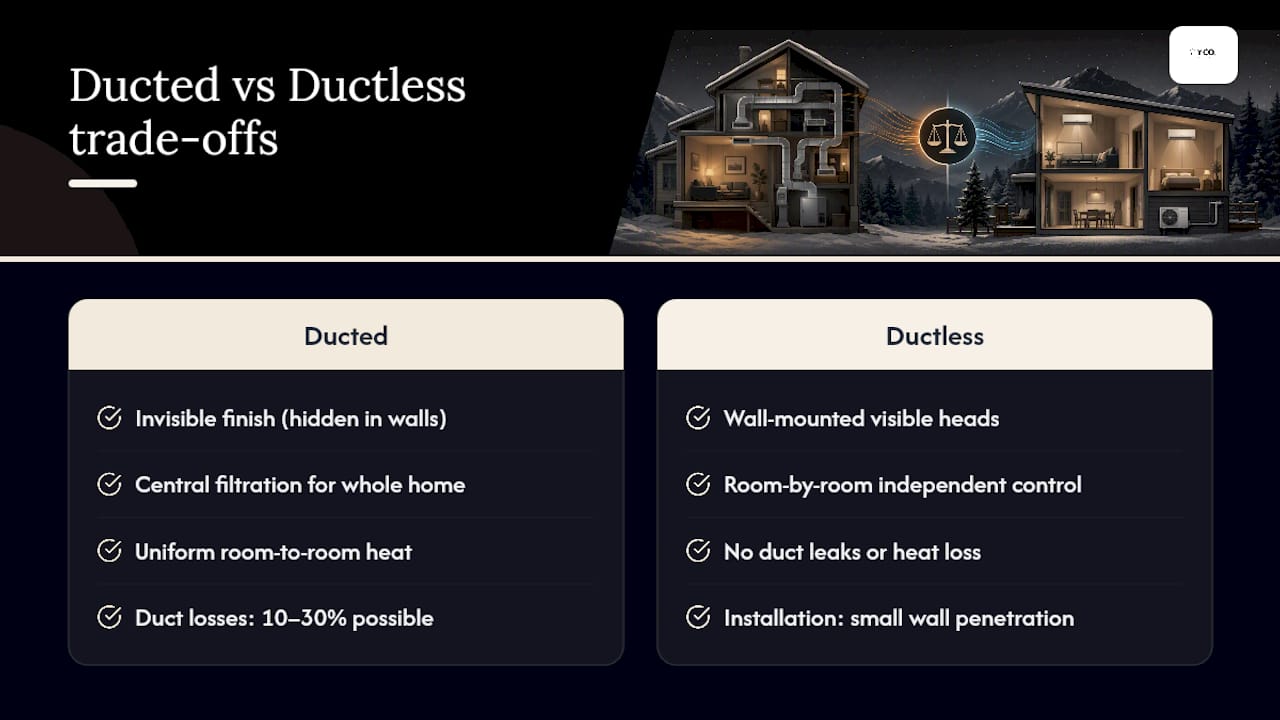
Ducted systems win on looks and consistency. Everything hides in the walls and ceiling, one central filter cleans the air for the whole house, and heat spreads evenly room to room. The catch: duct losses in older or poorly sealed systems can waste 10% to 30% of your conditioned air before it even reaches a register, and retrofitting ducts into a home that never had them means opening up ceilings and walls.
Ductless systems flip those trade-offs. You get room-by-room control that a single-zone ducted setup can't match, no ductwork to leak or lose heat through, and an installation that's mostly a small wall penetration and a mounting bracket. The downside is aesthetic and financial: indoor heads are visible on the wall, and adding more zones adds more equipment to buy, maintain, and eventually replace.
Ducted pros: invisible finish, central filtration, uniform distribution across the whole home. Ducted cons: duct losses, retrofit cost, ongoing duct maintenance. Ductless pros: independent zone control, minimal construction disruption, no duct losses. Ductless cons: visible units, rising per-zone costs, more indoor components to service.
Many homes don't need to pick a side. A hybrid setup, keeping the ducted system for main living areas and adding a single ductless head for a converted basement or a sunroom that never gets ductwork, solves a lot of retrofit headaches at once.
Pro Tip: Before ruling ductless out for cost reasons, price a single-zone unit for just your worst room. It's often cheaper than you'd guess, and it fixes the one space central air never handles well anyway.
What does ducted vs ductless actually cost?
Price ranges vary a lot by scope, but the pattern is consistent. A single-zone ductless install typically runs $3,000 to $6,500, while a multi-zone setup with three or four indoor heads often lands between $10,000 and $22,000, according to Greenfoot's Canadian cost breakdown. Ducted installs swing wider: smaller retrofits often start around $8,000 to $15,000, and larger projects with extensive new ductwork can reach $12,000 to $35,000 or more.
What actually drives the number on your quote:
- Whether existing ducts need sealing, repair, or full replacement
- How many indoor heads or zones you need
- Electrical upgrades and permit fees
- Line-set length between outdoor and indoor units
- Local labour rates and mounting complexity (attic access, brick exteriors, tight mechanical rooms)
Ask every contractor for an itemized quote that lists matched SEER/HSPF ratings for the exact equipment pair, permit costs, expected disruption, and warranty terms in writing. A heat pump installation guide for Canadian homeowners is a useful cross-check against regional pricing before you commit.
Which system performs better in cold weather?
SEER2 measures cooling efficiency and HSPF2 measures heating efficiency; higher numbers mean more comfort per dollar of electricity. Neither number means much on its own; what matters is whether the outdoor and indoor units are matched as a certified pair and whether the compressor uses inverter technology, which lets the system throttle output instead of cycling fully on and off.
Ductwork condition changes the math. A ducted system rated for high efficiency on paper can lose a meaningful chunk of that performance to leaky ducts, which is why sealing existing ductwork sometimes closes the efficiency gap with ductless entirely.
Cold-climate reality check: Modern cold-climate ductless units and cold-rated ducted heat pumps can keep working efficiently below minus 20 degrees Celsius when sized correctly. Don't assume either system struggles in winter based on old assumptions. Check the low-temperature capacity spec on the actual model, not the general category.
What does installation actually involve?
The visible disruption differs sharply between the two.
- Ductless install: A small hole is drilled through an exterior wall for the line set, an indoor head goes up on a wall bracket, and the outdoor condenser is mounted on a pad or bracket outside. Most single-zone jobs finish in a day or two.
- Ducted retrofit (existing ducts): Technicians inspect and pressure-test the ducts, seal or repair leaks, then swap the air handler and outdoor unit. This can often happen in a few days if the ducts are in decent shape.
- Ducted retrofit (no existing ducts): New trunk lines get run through soffits, dropped ceilings, or attic and crawlspace cavities. This is genuinely disruptive work, often stretching one to two weeks, and it usually requires opening finished ceilings.
Electrical upgrades and permits typically come into play whenever you're adding a new dedicated circuit for an outdoor condenser or upsizing an electrical panel. If HVAC work is happening alongside other renovation trades, ask your contractor how ductwork or head placement is sequenced against drywall, insulation, and electrical rough-in, so nothing gets closed up before an inspection.
How long do these systems last, and what breaks first?
Both system types need seasonal attention: clean or replace filters every one to three months, have coils and condensers professionally cleaned annually, and get ducts inspected for leaks every few years if you're running a central system.
- Air-source ducted heat pumps typically last 12 to 15 years.
- Ductless mini-splits often run 12 to 20 years, and either type can stretch toward 20 years with good maintenance and correct sizing.
- Watch for duct leaks and uneven room temperatures on ducted systems, and refrigerant loss or icing on indoor heads for ductless. Both point to a service call, not a DIY fix.
How do you choose between ducted and ductless?
Getting this decision right on paper saves you from a mismatched system that underperforms for a decade.
- Order a Manual J load calculation and a duct inspection. This is the industry-standard method for sizing equipment to your home's actual heat loss and gain, not a rule-of-thumb estimate. Insist your contractor documents the method used.
- Map your zones. List every room that needs independent temperature control, then pick the smallest number of indoor heads that covers them, since each additional zone adds cost.
- Request itemized quotes. Matched equipment efficiencies, line-set lengths, permit fees, and warranty terms should all appear as separate line items, not folded into one lump sum.
- Check rebates before you sign. Some regions run rebate programs that specifically favour ductless conversions for homes moving off oil heat or adding multiple zones, so it's worth checking your local utility or provincial energy program.
Pro Tip: Manufacturers like Lennox emphasize matched AHRI-certified equipment pairs for a reason: mismatched outdoor and indoor units rarely hit their rated efficiency, no matter how good the individual specs look.
How HVAC decisions fit into a full renovation
When we scope a full-home renovation, ductwork condition often decides more of the mechanical budget than the equipment itself. If ducts are undersized, leaky, or missing from an addition entirely, we're usually recommending a partial or full ductless solution for the new space rather than fighting to extend old trunk lines through finished ceilings.
Sequencing matters more than people expect. HVAC rough-in has to land before insulation and drywall close up the walls, and electrical needs to account for any new outdoor condenser circuit before the panel gets finalized. That's the kind of coordination that gets missed when three separate trades are booked independently. Cory Yefet manages that sequencing directly on every full-home renovation Y&CO Build takes on, so mechanical decisions get made alongside structural ones instead of after the walls are already closed.
— Cory
Where to verify the details
For the technical side, check Lennox's ducted vs ductless breakdown and Greenfoot's Canadian cost and cold-climate guide. Before signing a contract, check your provincial or municipal rebate portal and confirm the equipment is ENERGY STAR listed with a documented low-temperature capacity spec. If financing a larger retrofit alongside other renovation work, a HELOC calculator can help you figure out what's actually affordable before quotes come in.
Sources
- Mini-Split vs. Ducted Heat Pump for Canadian Homes | Greenfoot
- Ducted vs Ductless Heat Pump: Which to Choose? — Lennox
- Ductless vs. ducted heat pumps — Canada guide
FAQ
Is ductless better than ducted?
Neither is universally better; it depends on your home. Ductless usually wins for retrofits without existing ducts or for rooms needing independent control, while ducted wins when good ductwork already exists and you want one whole-home system.
What's better, a ducted or split system for whole-home comfort?
A ducted system generally delivers more even, whole-home comfort from a single thermostat, provided the ducts are sealed and sized correctly. A split (ductless) system can match that comfort room by room, but you're managing multiple zones instead of one.
What are common problems with ducted mini-splits?
Ducted mini-split systems (a less common hybrid that runs short duct runs from a mini-split air handler) can suffer from undersized ducts causing airflow noise, condensation in poorly insulated duct runs, and uneven distribution if zones weren't mapped correctly during design.
Which is better, a ducted or ductless chimney vent for a heat pump system?
Standard residential heat pumps, ducted or ductless, don't vent through a chimney; that question typically applies to gas furnaces or fireplaces, not heat pump equipment. If you're replacing a furnace with a heat pump, your installer will assess whether existing venting needs to be capped or repurposed.
How much does a ducted vs ductless installed system typically cost?
A single-zone ductless system typically runs $3,000 to $6,500 installed, while multi-zone ductless setups often land between $10,000 and $22,000. Ducted retrofits range more widely, from roughly $8,000 for smaller jobs to $35,000 or more when new ductwork is required throughout the home.