Yes, most Toronto homes with active knob and tube wiring need a full replacement, mainly to keep or restore home insurance and meet current safety expectations. Budget roughly $8,000 to $25,000 or more, depending on house size and whether a panel upgrade or asbestos removal is involved. The first move: book an inspection with a licensed electrical contractor and check your insurance renewal notice for a hard deadline.
TL;DR:
- Full-house knob and tube rewiring in Toronto costs between $8,000 and $25,000, with price variation based on house size, wall material, and complexity.
- Insurance providers are increasingly non-renewing policies on homes with active knob and tube wiring, often demanding full replacement within one to three years.
- Ontario requires a licensed electrical contractor to pull permits and conduct inspections, including a final ESA inspection and Form 1 for insurance proof.
- Major delays tend to come from asbestos testing, permit scheduling, and utility upgrades, so early planning of these steps can keep projects on schedule.
- Combining rewiring with larger renovations typically reduces overall costs and simplifies scheduling through a single point of contact.
Table of Contents
- What does knob and tube replacement cost in Toronto?
- Why do insurers and electricians treat knob and tube differently?
- What is the ESA permit and inspection process in Ontario?
- How long does a knob and tube replacement project take?
- Do I need a Toronto Hydro service upgrade too?
- How do you choose a licensed electrical contractor?
- Are there Toronto-specific rules beyond ESA requirements?
- What health and safety hazards come up during the work?
- Can you finance a knob and tube replacement?
- How Y&CO Build approaches rewires inside a renovation
- Get a managed rewire as part of your renovation
- Sources
- FAQ
What does knob and tube replacement cost in Toronto?
Cost depends far more on your house's specific complications than on square footage alone. A small semi with an accessible basement and attic is a different job than a three-storey Annex house with plaster walls and a finished third floor.
Local contractors and rewiring guides put full-house rewires in Toronto at roughly $8,000 to $25,000 or more, and where a project lands in that range comes down to a handful of variables:
- Small bungalow or semi (under 1,200 sq. ft.): Often the lowest end of the range, especially with an unfinished basement and accessible attic for running new cable.
- Two-storey detached home (1,500 to 2,500 sq. ft.): Mid-range pricing, particularly if walls are plaster and lath rather than drywall, since fishing wire through plaster means more patching.
- Large pre-war home with finished attic or basement: Pushes toward the top of the range or beyond it, because finished spaces mean opening and repairing ceilings and walls to reach the old wiring.
A few cost drivers show up on almost every quote. If your panel is still 60A or 100A, a 200A service upgrade typically gets bundled in, since new circuits need capacity the old panel can't provide. If your attic insulation is vermiculite, or if older plaster and lath contain asbestos, testing and abatement add a separate line item, sometimes a significant one, before any wiring work starts. And drywall or plaster repair after the electricians close up walls is its own cost, often underestimated by homeowners pricing a rewire in isolation.
One thing worth saying plainly: partial knob and tube removal, where you replace only the circuits an inspector flags, rarely satisfies an insurer's requirement. Most policies asking for K&T removal want the whole house off the old wiring, not a partial fix. Spending money on a partial job that still leaves active knob and tube in the walls is a common way homeowners waste a renovation budget without actually solving the insurance problem.
Why do insurers and electricians treat knob and tube differently?
Knob and tube wiring isn't automatically dangerous just because it's old, but it carries specific technical limitations that modern code and modern insurers both account for. The system has no ground wire, which matters for anything sensitive to power surges or for appliances that expect a grounded circuit. The original cloth and rubber insulation degrades over decades, especially where it's been buried under insulation added later, which traps heat the design never anticipated. And the wire gauge typically used decades ago wasn't sized for today's electrical load: dryers, air conditioners, multiple computers, and EV chargers running off circuits designed for a handful of lamps and a radio.
Insurers may give homeowners 1 to 3 years of notice before non-renewal, though several carriers have tightened that window in recent years, which is why checking your own policy's specific deadline matters more than assuming you have time.
Ontario's electrical code no longer allows new knob and tube installations, but existing wiring isn't automatically illegal or forced out by the province. The Electrical Safety Authority recommends replacing conductors that show deterioration, mechanical damage, overheating, or improper alterations, and requires a licensed electrical contractor and ESA inspection for any rewiring work performed.
The real pressure usually comes from insurers, not the government. Major carriers in Ontario, including several well known insurers, increasingly decline to renew policies on homes with active knob and tube circuits, or demand full replacement before they'll offer coverage at all. That's the practical trigger for most Toronto homeowners: not a code violation, but a letter from their insurance company.
What is the ESA permit and inspection process in Ontario?
Replacing knob and tube wiring in Toronto is not a project you can do informally, even if you're comfortable with tools. Ontario requires a Licensed Electrical Contractor (LEC) to pull the permit and perform the work, and the process runs through the Electrical Safety Authority from start to finish.
Here's what that process actually involves:
- Permit application: Your LEC applies for the electrical permit before work begins, providing project scope, address, and contractor licence details. Permit fees vary by project size but are typically a modest percentage of the overall job cost.
- Master Electrician oversight: Every licensed electrical contractor in Ontario must have a Master Electrician of record responsible for the technical quality of the work, even if a different licensed electrician is on-site day to day.
- Rough-in inspection: Once new wiring is run but before walls are closed up, an ESA inspector reviews the work. This is the point where problems get caught cheaply, before drywall goes back up.
- Final inspection: After the panel and finishing work are complete, ESA conducts a final inspection of the whole installation.
- Certificate of Inspection (Form 1): This is the document your insurer actually wants to see. It's the ESA's official confirmation that the work passed inspection and meets code, and it's what turns a project from "wiring was replaced" into "insurable proof the wiring was replaced."
Keep copies of both your permit and your Form 1 somewhere accessible, not just in your contractor's file. Insurers and future buyers will ask for it, sometimes years after the work is done, and tracking down paperwork from a contractor who's moved on is a headache you can avoid.
How long does a knob and tube replacement project take?
A typical Toronto knob and tube replacement runs two to six weeks from initial quote to final Form 1, though the range widens considerably if your home needs asbestos abatement or a Toronto Hydro service upgrade.
- Site visit and quote (days 1 to 7): A licensed contractor assesses your panel, attic and basement access, wall type, and any suspected asbestos or vermiculite before pricing the job.
- Permit application (days 3 to 10, often overlapping with the quote stage): Your LEC submits the ESA permit application once scope is confirmed.
- Abatement, if needed (1 to 3 weeks): Asbestos or vermiculite testing and removal, when required, happens before electrical work starts and is the single most common cause of schedule slippage.
- Rough-in wiring (1 to 2 weeks): Electricians run new cable through walls, attic, and basement, and install the new panel if one's part of the scope.
- ESA rough-in inspection (typically scheduled within a few business days of request): Inspector confirms wiring before walls close.
- Finishing and drywall repair (3 days to 2 weeks): Depends heavily on how much plaster or drywall needed to be opened.
- ESA final inspection and Form 1 issuance (a few business days after finishing): The last step before you can send documentation to your insurer.
The biggest delays aren't usually the wiring itself. They come from asbestos testing results, inspector scheduling during busy renovation seasons, and Toronto Hydro service upgrade lead times. Getting asbestos or vermiculite testing done early, before you finalize your contract, is one of the most effective ways to keep a rewire on schedule.
Do I need a Toronto Hydro service upgrade too?
Most Toronto homes still running on knob and tube also have a 60A or 100A electrical service, and that capacity was fine for a 1940s household but isn't enough for a modern one with central air, an EV charger, and a kitchen full of appliances. Contractors routinely recommend a 200A service upgrade alongside a rewire, since running new circuits into an undersized panel just moves the capacity problem rather than solving it.
- Toronto Hydro handles service upgrades through an online service upgrade request process, which your electrician typically initiates on your behalf once the new panel size is confirmed.
- Utility scheduling adds its own lead time on top of your electrician's rough-in and finishing schedule, so this step needs to start early, not as an afterthought once wiring is underway.
- Budget for the panel and service upgrade as a distinct line item. It's commonly bundled into the same quote as the rewire but priced separately, since it involves different labour and materials than the interior wiring work.
Pro Tip: Ask your electrician to submit the Toronto Hydro service upgrade request in the same week they file your ESA permit application. Running both in parallel, rather than one after the other, is often what separates a four-week project from a seven-week one.
Electrical capacity also matters beyond the rewire itself. The City of Toronto's own guidance on electrical capacity upgrades notes that panel capacity affects whether a home can later support a heat pump or EV charger, so it's worth sizing your new service for where your household is headed, not just where it is today.
How do you choose a licensed electrical contractor?
Not every electrician advertising rewiring work in Toronto is set up to deliver what your insurer actually needs. Before signing anything, confirm the contractor holds an active licence through the ESA's Find a Licensed Electrical Contractor tool, and ask them to name the Master Electrician responsible for the work.
On-site, a short list of questions separates contractors who do this regularly from ones who don't:
- Who pulls the ESA permit, and can I see a copy once it's filed?
- How do you handle asbestos or vermiculite testing if the attic or walls turn one up?
- Is the panel or service upgrade included in this quote, or priced separately?
- What's the realistic timeline to final ESA inspection and Form 1?
- Will I receive the Certificate of Inspection directly, or do I need to request it?
A vague answer to any of those, especially around Form 1, is a red flag worth taking seriously.
| What a solid written quote includes | Why it matters |
|---|---|
| LEC licence number and named Master Electrician | Confirms legal authority to pull permits and perform the work |
| Scope: full vs. partial replacement | Partial jobs often don't satisfy insurer requirements |
| Panel/service upgrade, itemized separately | Prevents surprise costs mid-project |
| Asbestos/vermiculite contingency clause | Protects you from open-ended change orders |
| Timeline to Form 1, not just "completion" | Form 1 is what your insurer actually needs |
Are there Toronto-specific rules beyond ESA requirements?
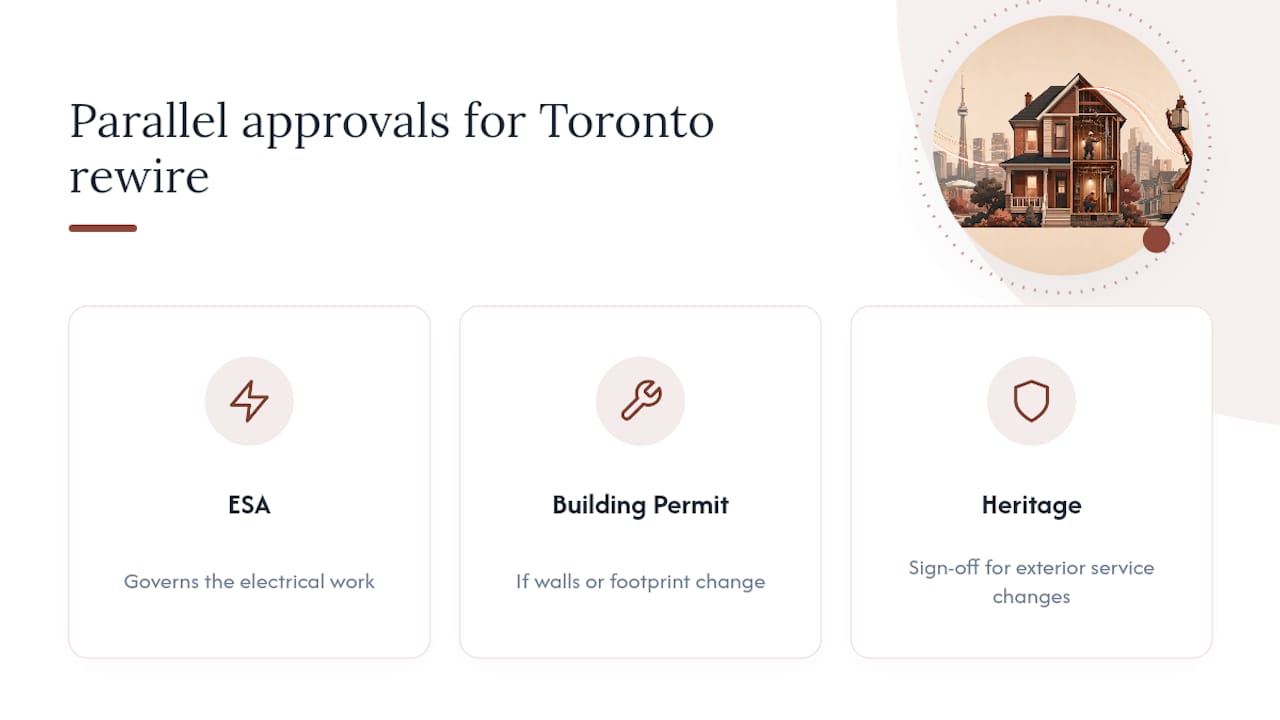
Provincial ESA rules govern the electrical work itself, but Toronto layers on its own building permit and zoning requirements the moment your rewire touches structural elements or changes the footprint of finished space. If your project includes opening walls for other renovation work, adding a subpanel in a converted basement, or altering a space to accommodate new circuits, a Toronto building permit may run alongside your electrical permit, not instead of it.
Toronto's building code enforcement also applies to any drywall, plaster, or structural repair needed after wiring is run, particularly in older homes where wall assemblies may not meet current fire separation standards once opened up. This is one reason electrical rewiring in a century home often becomes a small renovation rather than a single-trade job. If your project intersects with an addition or a larger structural change, permit and zoning coordination becomes its own workstream worth planning for early rather than discovering mid-project.
Heritage designation is worth checking too. If your property sits within a Heritage Conservation District or carries individual heritage listing, exterior work tied to service upgrades, like a new hydro meter location or mast, may need additional sign-off before Toronto Hydro or your electrician can proceed. It's a narrow case, but one that catches homeowners in neighbourhoods like Cabbagetown or the Annex off guard when they assume electrical work is exempt from heritage review.
What health and safety hazards come up during the work?
Rewiring a century-old Toronto home isn't just a matter of running new cable. Opening walls and attics that have sat undisturbed for decades exposes hazards that have nothing to do with electricity itself.
Vermiculite insulation, common in Toronto attics installed before the 1990s, sometimes contains asbestos fibres from the Zonolite product line, and disturbing it without proper containment risks airborne exposure for everyone in the house, not just the workers. Plaster and lath walls built before the 1980s may also contain asbestos in the plaster compound itself, which is why testing before demolition matters more than most homeowners expect going in.

There's also a live-wiring risk during the transition period. Knob and tube circuits that are old and worn are more prone to arcing or overheating when disturbed, which is part of why licensed electricians de-energize circuits section by section rather than working around live wiring. Homeowners should stay out of active work zones entirely during the rough-in phase, keep pets and kids away from open wall cavities, and avoid running space heaters or high-draw appliances on any circuit currently being worked on. A good contractor will flag these precautions unprompted; if they don't, ask.
Can you finance a knob and tube replacement?
A full rewire is rarely a discretionary expense homeowners have cash sitting aside for, so financing options matter as much as the cost estimate itself. Several paths are common among Toronto homeowners facing this project.
A home equity line of credit (HELOC) is the most frequently used option, since it typically carries lower interest than unsecured credit and lets you draw only what the project needs. Homeowners who are already planning a larger renovation sometimes fold the rewire into their renovation mortgage or refinance, spreading the cost across the broader project financing rather than treating it as a standalone bill. Some contractors also offer in-house payment plans or partner with third-party renovation financing companies, splitting the cost into instalments tied to project milestones like rough-in completion and final inspection.
It's also worth calling your insurer before you finance anything. If a non-renewal notice is what's driving the project, some insurers will accept a signed contract and permit number as interim proof that work is underway, which can buy time on coverage while financing and scheduling come together. Get that in writing rather than relying on a verbal assurance from an agent.
How Y&CO Build approaches rewires inside a renovation
When a rewire lands alongside kitchen, bathroom, or structural work, Y&CO Build's single point of contact coordinates permits, trade sequencing, and finishes so the electrical work doesn't become a separate, disconnected project layered on top of everything else.
— Kelly
Get a managed rewire as part of your renovation
If you're weighing whether to hire a standalone electrician for the rewire or fold it into broader renovation plans, there's a real cost argument for the second option: opening walls once for wiring, plumbing, and finishes together is almost always cheaper per finished square foot than opening them twice on separate projects and timelines. Y&CO Build's full-home renovation service is built around exactly that overlap, with Cory Yefet as the single point of contact managing the electrical permit, Toronto Hydro coordination, drywall repair, and finish work as one sequenced project rather than a string of separate contractor handoffs.

That single-contact structure matters most when a rewire surfaces mid-renovation, which happens often once walls are open and old wiring is discovered. Rather than pausing to find a separate electrician and re-coordinate schedules, the electrical work gets folded into the renovation's existing permit and trade sequence. You can see how that coordination plays out in a completed project like the Galley Avenue renovation in Roncesvalles, or review the full eight-stage renovation process Y&CO Build follows from feasibility study through completion.
If your home has active knob and tube wiring and you're already thinking about a larger renovation, reach out for a site visit and estimate before committing to a standalone electrical contract.
Sources
- Flash 25-05-FL: Knob and tube wiring in residential installations — ESA
- Service upgrade request - Toronto Hydro
FAQ
How expensive is it to replace knob and tube wiring?
Full-house rewires in Toronto typically run $8,000 to $25,000 or more, depending on house size, whether a panel upgrade is needed, and whether asbestos or vermiculite abatement is involved. Smaller homes with easy attic and basement access land at the lower end; larger pre-war homes with finished spaces and plaster walls push toward the higher end.
Does home insurance cover knob and tube wiring in Ontario?
Many Ontario insurers no longer renew policies on homes with active knob and tube circuits, and some refuse coverage outright until the wiring is fully replaced. Insurers may give homeowners one to three years' notice before non-renewal, though that window has tightened with some carriers in recent years, so checking your own policy's deadline is essential.
Is knob and tube wiring legal in Ontario?
Existing knob and tube wiring isn't illegal, but Ontario's electrical code no longer permits new installations of it. The ESA recommends replacing conductors that show deterioration, damage, overheating, or improper alterations, and any rewiring must be done by a licensed electrical contractor with ESA inspection.
Can you sell a house with knob and tube wiring in Ontario?
You can legally sell a house with knob and tube wiring, but buyers often struggle to get insurance approved, which can complicate or delay a closing. Many buyers and their lenders now request proof of replacement or a signed contract for replacement as a condition of financing, making it a practical, if not legal, barrier to a smooth sale.
Should I bundle my rewire with other renovation work?
If you're already planning a kitchen, bathroom, or structural renovation, bundling the rewire in usually costs less than doing them separately, since walls only need to be opened once. Y&CO Build's full-home renovation service manages the electrical permit and inspection process as part of the broader project rather than as a standalone contract.