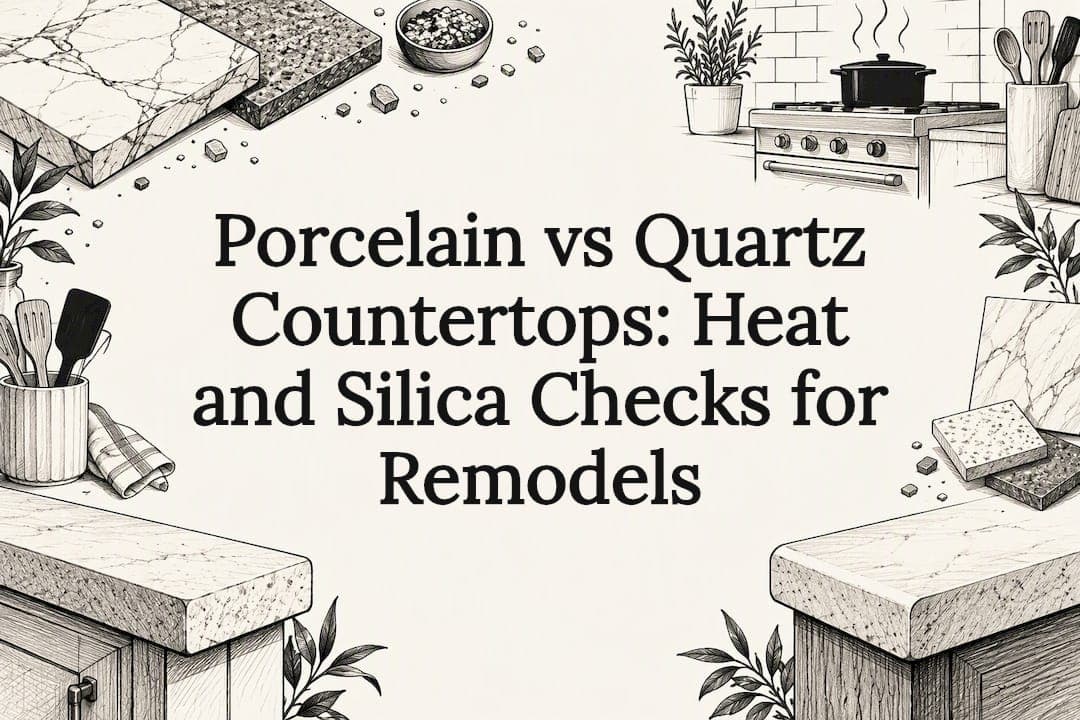
Quartz wins on pattern variety, chip resistance, and indoor durability, while porcelain takes the lead for heat tolerance, UV stability, and outdoor use. If you're renovating a kitchen with heavy cooking habits and want bold veining, quartz is usually the easier choice. If you're building an outdoor kitchen or want a surface that shrugs off direct sun and hot pans, porcelain tends to perform better. Either way, who fabricates and installs the slab matters as much as which material you pick.
TL;DR:
- Quartz’s resin can discolor under sustained heat, so use trivets for hot pans; its deeper, repeatable veining suits large islands.
- Thin porcelain may chip at exposed corners and needs reinforced cabinetry or engineered support, so confirm substrate requirements before ordering a waterfall island.
- Fabrication complexity changes installed costs: waterfall edges, sink cutouts, and tight seams add labor, while porcelain may require extra cabinetry blocking.
- Ask contractors whether quartz cutting happens away from your home or uses wet methods and HEPA extraction, and confirm the local exposure limit.
- Quartz warranties can depend on approved cleaners; mild soap and water work for both materials, but strong solvents can dull quartz’s resin finish.
Table of Contents
- What quartz countertops are: composition and design options
- What porcelain countertops are: manufacturing and trade-offs
- Durability, heat, chips, and looks compared
- Cost, installation complexity, and timeline
- Everyday care: what protects each surface
- Fabrication safety and silica exposure during installation
- How to choose between porcelain and quartz: a decision checklist
- Long-term performance and warranty comparisons
- Compatibility with different kitchen layouts and renovation designs
- Advising clients on countertop choice during a full renovation
- Getting your countertop choice specified and installed correctly
- FAQ
- Sources
What quartz countertops are: composition and design options
Quartz countertops are engineered from crushed quartz mixed with resin binders and pigments, then compressed and cured into slabs. That resin content is what makes deep, repeatable veining possible across large surfaces, but it also makes the material more sensitive to sustained high heat than a fired ceramic surface would be. Engineered stone can contain a high proportion of silica, with resin filling the rest, a composition that trades heat tolerance for consistent patterning and colour depth, according to CCOHS.
Most quartz lines offer:
- Polished, honed, or textured finishes that mimic marble or granite.
- Deep, through-body veining that holds up even after edge profiling or sink cutouts.
- Consistent slab-to-slab colour matching, useful for large islands or seamless runs.
Manufacturer warranties on quartz typically assume routine care and specific cleaning products, so it's worth reading those terms before you commit to a finish or edge style.
What porcelain countertops are: manufacturing and trade-offs
Porcelain slabs start as vitrified clay and mineral blends fired at very high kiln temperatures, which produces an extremely hard, dense surface with strong thermal stability, according to Caesarstone's porcelain care guidance. That firing process is why porcelain holds up well under direct sun and sustained heat, making it a common choice for outdoor kitchens, pizza ovens, and sun-exposed patios.
Key characteristics worth knowing before you choose porcelain:
- Exceptional hardness and scratch resistance across the full slab thickness.
- UV stability that prevents fading or yellowing outdoors.
- Thinner slab formats that look sleek but sometimes chip at exposed edges under impact.
- A need for properly engineered substrate and cabinetry support, since thin porcelain relies on solid backing rather than slab mass alone.
That last point matters most during installation planning, since porcelain's thinness shifts some structural responsibility onto your cabinetry and support work.
Durability, heat, chips, and looks compared
Both materials perform well in daily kitchen use, but they diverge sharply once you get specific about how you cook, how you decorate, and whether you're building outdoors.
- Scratch resistance: porcelain's fired surface resists knife marks and daily wear slightly better than quartz, though both tolerate normal cutting board use without visible damage.
- Heat tolerance: porcelain handles hot pans and direct sun without discolouring, while quartz's resin content means trivets are effectively mandatory for anything straight off the stove, a direct consequence of the resin binding described by CCOHS.
- Chip and edge behaviour: quartz's denser, thicker format resists chipping at standard edges better than thin porcelain, which can chip at exposed corners or waterfall island edges under sharp impact.
- Appearance: quartz offers more repeatable, deep-set veining across large runs, while porcelain's printed patterns can look slightly flatter up close despite matching well from a distance.
- Outdoor suitability: porcelain's UV resistance and thermal stability make it the practical pick for uncovered outdoor kitchens, while quartz is generally reserved for covered or indoor spaces.
Engineered stone can contain a high proportion of silica, a composition that explains both its durability and its heat sensitivity compared with fired ceramic surfaces, per CCOHS.
For a busy family kitchen with constant pot and pan traffic, quartz's chip resistance and pattern consistency often outweigh its heat limits, as long as trivets become a habit. For an outdoor entertaining space or a kitchen with a wood-fired oven nearby, porcelain's thermal stability removes a worry that quartz can't fully address.
Cost, installation complexity, and timeline
Installed pricing for both materials depends heavily on slab size, edge profile, sink cutouts, and how complex the fabrication is, so broad cost ranges are less useful than understanding what drives the final number.
- Large-format or waterfall-edge installations increase fabrication time and labour regardless of material.
- Porcelain's thin-slab format often requires added cabinetry blocking and reinforced substrate, which can extend carpentry work, according to Caesarstone's cost guidance.
- Quartz slabs are heavier per square foot, which can require sturdier cabinet bases but typically less substrate modification than thin porcelain.
- Complex sink types (undermount, farmhouse) and tight seams add fabrication days on both materials.
Budgeting a contingency for substrate work or cabinetry adjustments protects your timeline, especially if you're choosing large-format, thin porcelain for a waterfall island. Our guide to face frame versus frameless cabinetry covers how cabinet construction interacts with countertop support needs.
Everyday care: what protects each surface
Quartz responds best to mild soap and water, and manufacturer guidance specifically discourages oven cleaners, floor strippers, and other strong solvents that can dull the resin finish, according to Caesarstone's quartz care notes. Disinfectant wipes should be rinsed off promptly rather than left to dry on the surface.
Porcelain tolerates a wider range of cleaners thanks to its fired, non-porous structure, but hydrofluoric acid and other highly aggressive chemical cleaners should still be avoided, per Caesarstone's porcelain care page.
- Stick to mild soap and water for daily cleaning on both materials.
- Avoid abrasive pads that can dull polished finishes over time.
- Check your specific manufacturer's warranty terms, since using an unlisted cleaner can void coverage.
Pro Tip: Keep the manufacturer's care sheet in a kitchen drawer so anyone cleaning the counters knows which products are off limits.
Fabrication safety and silica exposure during installation
Engineered quartz fabrication generates respirable crystalline silica dust, a recognized occupational hazard that requires wet-cutting and proper dust extraction to manage safely, according to CCOHS. Provincial exposure limits differ, with Ontario's time-weighted average higher than British Columbia's limit, so the applicable standard depends on where the work happens, per recent Canadian coverage of silica exposure.
Before fabrication begins, ask your contractor:
- Whether cutting happens off-site or with verified wet-cutting and HEPA extraction on-site.
- What training and insurance coverage their fabrication crew carries.
- Which provincial exposure limit applies to your project location.
A contractor unwilling to answer these questions, or one proposing dry-cutting indoors, is a scheduling and safety red flag worth avoiding.
How to choose between porcelain and quartz: a decision checklist
Match your priorities to the material before you fall in love with a specific slab pattern.
- Identify your primary use: heavy cooking and knife work favours either material, but constant hot-pan contact pushes toward porcelain.
- Decide on outdoor exposure: any uncovered outdoor installation should default to porcelain for UV and thermal stability.
- Set your aesthetic priority: deep, repeatable veining points to quartz, while a matte, stone-like finish with thin profiles points to porcelain.
- Confirm your budget and substrate needs: thin porcelain may need extra cabinetry reinforcement, which should factor into your total cost.
- Request warranty and fabrication safety documentation: ask for manufacturer warranty terms and contractor silica-safety practices before signing.
Pro Tip: Bring a sample of your cooktop's heat output or a photo of your planned sink style to the showroom, it helps fabricators flag substrate or heat concerns early.
Long-term performance and warranty comparisons
Both materials are built for decades of use, but their warranty structures reflect different failure points. Quartz warranties typically cover resin-related issues like discolouration or delamination, with coverage length varying by manufacturer and tied closely to using only approved cleaning products. Porcelain warranties often focus on structural cracking or chipping, since the fired surface itself rarely discolours or stains under normal use.
Long-term, porcelain tends to hold its original colour and finish better in sun-exposed or high-heat settings, while quartz tends to hold up better against daily chip-prone impacts like dropped cookware. Neither material degrades meaningfully from routine water exposure, which sets both apart from natural stone options that need periodic sealing.
Reading the fine print matters more than the headline warranty length. A 15-year warranty that excludes any cleaner outside a short approved list offers less real protection than it sounds. Ask your contractor or showroom to walk through exclusions before you finalize a material, especially if your household already uses specific cleaning products you don't want to replace.

Compatibility with different kitchen layouts and renovation designs
Quartz's weight and slab consistency make it a strong fit for large, uninterrupted runs, islands with waterfall edges, and kitchens where seam placement needs to be nearly invisible. Its heavier mass does mean cabinet bases need to be built to spec, which is worth flagging early if you're also reworking your cabinetry layout, as covered in our comparison of LVP and laminate flooring choices that touches on how material weight and substrate planning intersect during a full remodel.
Porcelain's thinner profile suits contemporary, minimalist layouts where a slim edge reads as a design feature rather than a limitation. It also works well for mixed indoor-outdoor kitchen designs, since the same material can run from an interior island to an uncovered patio counter without a UV or heat concern splitting the design. Galley kitchens with tight clearances benefit from porcelain's lighter weight during installation, which can simplify manoeuvring large slabs into narrow spaces.
Whichever layout you're planning, loop in your cabinetry and countertop choices at the same design stage rather than sequentially, since edge profiles, sink types, and substrate needs all shift depending on the layout you land on.

Advising clients on countertop choice during a full renovation
When I'm planning a kitchen remodel with a homeowner, countertop choice never happens in isolation from cabinetry, plumbing, and structural work. Coordinating all three at once avoids the costly surprises that come from picking a slab before the support underneath it is confirmed.
— Cory
Getting your countertop choice specified and installed correctly
Choosing between porcelain and quartz is only half the decision. The other half is making sure your cabinetry, substrate, and fabrication schedule are planned around the material you pick, which is exactly where a coordinated renovation team earns its keep.
Through our full-home renovation services, we handle:
- Material advising that weighs your layout, budget, and daily use against porcelain and quartz trade-offs.
- Structural and substrate checks before any slab is ordered.
- Contractor coordination so fabrication, cabinetry, and plumbing stay on the same schedule.
- Full installation management from feasibility through final walkthrough.
If you're also weighing Toronto-area showroom options, this local comparison of porcelain and quartz is a useful starting point for material research before your consultation. When you're ready to plan a full kitchen remodel or larger renovation, reach out through Ycobuild to start a consultation.
FAQ
Are porcelain or quartz countertops better?
Neither material is universally better. Porcelain suits outdoor kitchens and high-heat tasks thanks to its fired, UV-stable surface, while quartz suits indoor kitchens wanting bold, repeatable patterning and strong chip resistance.
Why is quartz losing popularity in some renovations?
Some homeowners are moving away from quartz due to its sensitivity to sustained heat and the silica exposure concerns tied to fabrication, which has pushed interest toward porcelain and other alternatives, according to recent Canadian silica exposure coverage. It remains a durable, widely available option for many kitchens.
What cleaning products should you avoid on quartz countertops?
Avoid oven and grill cleaners, floor strippers, and other strong solvents, since these can dull or damage the resin finish, according to Caesarstone's quartz care guidance. Mild soap and water is the recommended routine cleaner.
What is the most durable countertop material available?
Porcelain and quartz both rank among the most durable countertop options, with porcelain offering stronger heat and UV resistance and quartz offering stronger chip resistance at standard edges. The better fit depends on whether your priority is outdoor durability or indoor impact resistance.
What should you check before hiring a contractor for countertop installation?
Confirm the contractor's fabrication safety practices, including wet-cutting and dust extraction methods, and ask to see manufacturer warranty terms for your chosen material. Checking that the provincial silica exposure limit for your location is being followed protects both your installation crew and your project timeline, per CCOHS guidance.
Sources
- CCOHS: Engineered stone countertops
- Respirable crystalline silica in Canada (2026 guide) — Workman Industrial
- Porcelain surfaces — Caesarstone Canada