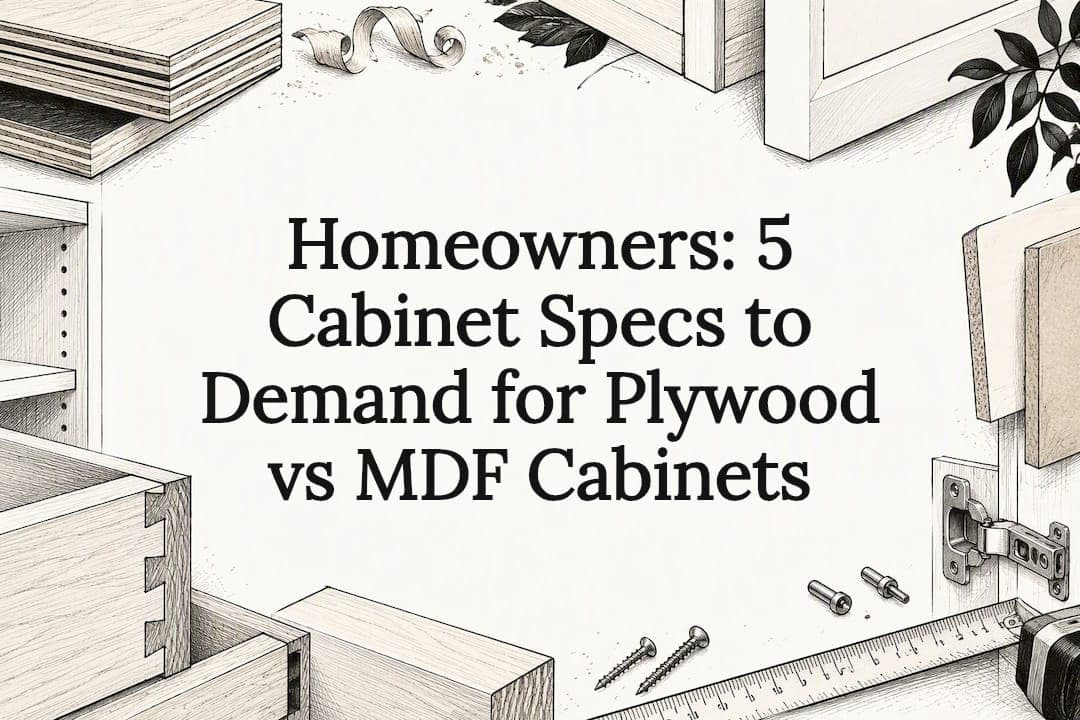
Use plywood for structural boxes and repeated hardware; use MDF for painted doors and detailed routed profiles. Hybrids are common, and most well-built kitchens use both. This page explains the trade-offs, costs and the exact questions to ask your cabinetmaker, so you can specify materials with confidence, rather than guesswork.
TL;DR:
- Plywood is best for cabinet boxes, shelves, and wide spans due to its strength, durability, and superior screw retention.
- MDF is ideal for painted doors and Decorative profiles because of its smooth surface and predictable machining, but edges require sealing in humid environments.
- Particleboard remains a budget option but is less durable and not recommended for load-bearing or moisture-rich areas.
- Always specify panel grade, thickness, and edge treatment in writing, and verify formaldehyde emissions compliance due to health regulations.
- A hybrid approach with plywood for structural components and MDF for decorative doors commonly offers the best value and performance in kitchen cabinetry.
Table of Contents
- Plywood vs MDF cabinets at a glance
- Structural performance: strength, screw holding and longevity
- Finishability and machining: MDF's strengths for painted doors
- Moisture, durability and emissions: real risks and compliance to check
- Cost and value: where to spend and where to save
- Decision checklist: pick plywood, MDF or a hybrid for each cabinet part
- Material schedule and documentation to request from your cabinetmaker
- Contractor perspective: why a hybrid approach often wins in real renovations
- How we help you specify and install the right cabinet materials
- FAQ
- Sources
Plywood vs MDF cabinets at a glance
Plywood and MDF solve different problems, and knowing which part of the cabinet you're specifying narrows the choice fast.
- Plywood pros: strong screw retention, resists sagging over wide spans, holds up to repeated hardware mounting.
- Plywood cons: visible veneer layers on edges, can show grain through paint.
- MDF pros: dense and uniform, machines cleanly for routed profiles, sands and paints to a glass-smooth finish.
- MDF cons: swells if edges aren't sealed, weaker screw-holding in high-stress joints.
- Best fit: plywood for box sides, bottoms, backs and shelves; MDF for doors, drawer fronts and decorative mouldings.
Particleboard sits below both as a budget option: lower cost, lower durability, and generally not recommended where weight-bearing or moisture exposure is a factor.
Structural performance: strength, screw holding and longevity
Plywood's cross-laminated veneer construction distributes loads across layers running in alternating directions, which limits warping and spreads stress away from any single fastener point. That structure is why plywood is the default choice for cabinet boxes, especially where shelves span wide openings or drawers carry heavy loads repeatedly.

Screw retention matters more than most homeowners expect. Drawer slides, hinges and shelf pins get mounted and remounted over a cabinet's life, and plywood's layered grain holds threads better than a homogeneous panel under repeated stress. MDF can still work in low-stress applications, but it tends to strip out faster when screws are removed and reinserted.
Not all plywood performs the same; understanding why panel grade and construction matter can help ensure a finished cabinet appearance that meets your expectations, as explained in detail by design premium. Grade, species and thickness change the outcome significantly: a thin, low-grade panel with voids in the core will flex and fail faster than a properly specified sheet. CSA O151:17 sets out construction, bonding and grading requirements for Canadian softwood plywood, and asking for the specific grade protects you from a quote that substitutes a weaker panel. For wide spans or heavy-use drawers, a thicker panel or an engineered alternative may be worth the extra cost.
Finishability and machining: MDF's strengths for painted doors
MDF's uniform density and smooth surface make it the material of choice when the goal is a flawless-painted finish. Because MDF is flat, dense and free of grain or voids, it machines and sands predictably, which means routed profiles, raised panels and decorative edges come out crisp and consistent across every door in the kitchen. Plywood, by contrast, can show grain telegraphing through paint even after priming.
That same density creates a maintenance requirement: MDF edges must be sealed before finishing. Exposed MDF edges absorb moisture and swell, so edge banding, a quality primer, or a sealed MDF edge profile is non-negotiable on any door or panel that will see humidity.

When a project calls for a natural wood look rather than paint, veneered plywood or solid wood doors are the better choice. MDF only accepts paint and some foil finishes well; it isn't suited to a stained or clear-coat wood appearance.
Moisture, durability and emissions: real risks and compliance to check
Neither material is waterproof in its ordinary form. Plain MDF swells and loses structural integrity when it sits in standing water, and ordinary plywood can delaminate at the edges if moisture gets between veneer layers over time. Expect problems under sinks, near dishwashers or in poorly ventilated bathrooms unless the panel is specifically rated for moisture exposure.
Adhesives, product classification and panel grade all influence how a sheet handles moisture, which is why "plywood" or "MDF" alone isn't a complete specification. Ask for the bonding type and moisture rating in writing.
Formaldehyde emissions are the other compliance issue to check. Since January 7, 2023, Canada has prohibited the import or sale of non-compliant composite wood products, so request proof of compliance and labelling for any MDF or plywood panels used in your cabinets. Health Canada notes that formaldehyde emissions increase with higher temperature and humidity, which makes kitchen ventilation part of the material decision, not just an afterthought.
Cost and value: where to spend and where to save
Plywood typically costs more per sheet than MDF, but the real comparison is installed assembly cost, not board price alone. A plywood box with a painted MDF door often lands close to an all-plywood cabinet once labour, finish and hardware are factored in.
Spend on plywood where screw retention and rigidity matter most: drawer boxes, cabinet carcasses, anything carrying repeated hardware stress. Save with MDF where a smooth painted surface is the goal and structural load is low, such as doors and decorative panels.
A few details stretch the budget further: slightly thicker panels in high-stress areas, properly sealed edges on every MDF component, and quality hardware that won't need replacing in two years.
Decision checklist: pick plywood, MDF or a hybrid for each cabinet part
Work through this in order rather than choosing one material for the whole kitchen.
- Identify the function first. Decide whether you're specifying a box, a door or a shelf, since each has different stress and finish demands.
- Weigh the environment. Flag any cabinet near a sink, dishwasher or exterior wall, where humidity and splashing make moisture resistance a priority.
- Count the hardware cycles. Drawers and heavily used hinges favour plywood for screw retention; static doors can go either way.
- Put the specification in writing. Request panel grade, thickness and edge treatment for every component before signing a quote.
- Default to the hybrid. Plywood boxes paired with painted MDF doors cover most kitchens well; deviate only where a stained wood look or an unusually heavy load changes the calculation.
Pro Tip: Ask your cabinetmaker to show you a sample edge-banded MDF door and a plywood box corner before you commit, so you can see the finish and joinery quality in person.
Material schedule and documentation to request from your cabinetmaker
A written material schedule protects you from a quote that quietly substitutes a cheaper panel in one part of the cabinet. Ask for a line-by-line breakdown covering box sides, bottoms, backs, shelves, doors and drawer boxes, with the thickness, edge treatment and panel grade specified for each.

Request formaldehyde compliance labels or certificates for any composite panels used, since CANFER requires finished goods to include only certified panels. Confirm who seals exposed edges on site, and get clarity on how warranty or install damage will be handled before work begins.
This accountability model uses one point of contact to track every material decision from quote to install, so nothing gets substituted without your sign-off.
Contractor perspective: why a hybrid approach often wins in real renovations
On most kitchen jobs we spec plywood boxes with painted MDF doors because it balances structural durability against finish quality without overspending on either. A client who wants a flawless painted door and a drawer box that still holds tight after years of use doesn't have to choose. The trade-off worth remembering is lifecycle: a sealed edge and a solid warranty matter more than the material name on the quote.
— Cory
How we help you specify and install the right cabinet materials
Choosing between plywood and MDF is one of dozens of material decisions that come up in a full kitchen renovation, and getting it wrong in a quote is easy to miss if nobody is tracking every line item. We manage material selection, specification and contractor coordination end to end, with a single point of contact from the feasibility study through to final walkthrough.
That means:
- One person reviewing every material schedule, so panel grade, thickness and edge treatment match what you agreed to pay for.
- Direct coordination with designers and tradespeople to avoid substitutions that show up only after installation.
- Clear, realistic pricing tied to the materials actually specified, not a generic allowance.
If you're planning a full-home renovation or an addition that includes new cabinetry, reach out to book a consultation and we'll walk through the material choices with you before anything goes to quote.
FAQ
Are Ikea cabinets plywood or MDF?
Ikea cabinet boxes are typically particleboard rather than plywood or MDF, with doors available in various MDF-based or wood veneer finishes depending on the line. Always check the specific product's material listing, since finishes and core materials vary by cabinet series.
Is it better to make cabinets out of plywood or MDF?
Plywood tends to perform better for cabinet boxes because of its screw retention and resistance to sagging, while MDF machines and paints more smoothly for doors and detailed profiles. Most well-specified kitchens use plywood boxes with MDF doors rather than one material throughout.
What lasts longer, MDF or plywood?
Plywood generally holds up longer under repeated hardware stress and heavy loads because its layered construction resists flexing and fastener pull-out. MDF can last just as long in low-stress applications like doors, provided the edges are sealed and the panel isn't exposed to standing moisture.
Do high-end cabinets use plywood?
High-end cabinetry commonly uses plywood for boxes and drawer construction because of its strength and screw-holding performance, often paired with MDF or solid wood for doors depending on the desired finish. The specific grade and species of plywood, not just the material name, is what separates a premium build from a basic one.