For roofs where cooling costs and sun exposure drive the budget, TPO is usually the smarter pick. For cold-climate buildings, simple roof geometry, or projects where budget and easy repairs matter most, EPDM tends to win out. The right answer still depends on your ownership horizon, the warranty fine print, and whether you hire a certified installer, so treat this as a starting point, not a final verdict. The comparison below breaks down exactly where each membrane pulls ahead.
TL;DR:
- TPO is better suited for buildings with high cooling loads due to its high reflectivity and faster return on investment through reduced HVAC costs.
- EPDM offers greater flexibility and easier repairs in cold climates, hail-prone regions, and on simple roof shapes, often outperforming TPO in durability over decades.
- Seam technology is the key difference: TPO seams are heat-welded for a continuous bond, while EPDM relies on tape or adhesive, affecting long-term maintenance needs.
- Installation conditions are critical: TPO requires dry, warm weather to weld properly, whereas EPDM seams can be installed in colder temperatures with less sensitivity.
- When choosing, consider your climate, roof complexity, foot traffic, and ownership timeline; verify membrane thickness, reflectance index, and warranty specifics to avoid early issues.
Table of Contents
- TPO vs EPDM roofing: a side-by-side comparison
- What is TPO and how does it actually perform?
- What is EPDM and where does it hold its own?
- Cost of TPO roofing vs cost of EPDM roofing over time
- Installation, inspection, and common roof repairs
- How do you choose between TPO and EPDM for your building?
- How roof choices fit into a full renovation plan
- Standards and datasheets worth reading before you sign
- Sources
- FAQ
TPO vs EPDM roofing: a side-by-side comparison
The two membranes solve the same problem (keeping water out of a low-slope roof) with different chemistry, and that difference shows up in almost every performance category.
Seams: TPO seams are heat-welded, creating a continuous, fused bond that behaves more like one sheet than two pieces glued together. EPDM seams rely on tape or liquid adhesive, and industry comparisons identify seam technology as the single biggest technical distinction between the two systems, since taped seams need more inspection and re-sealing over the decades.
Energy and reflectivity: White TPO reflects far more solar heat than black EPDM, and Natural Resources Canada notes that cool-roof surfaces can cut cooling-related HVAC costs by roughly 10 to 30 percent on buildings where air conditioning is a major line item.
Cold flexibility: EPDM stays pliable at low temperatures better than TPO, which stiffens and gets harder to detail around penetrations in freezing weather.
Resistance: TPO generally handles grease, solvents, and hydrocarbon exposure better, which matters for restaurant exhaust zones. EPDM has a long track record against UV and ozone degradation on simple, open roof fields.
Cost and lifespan: Installed costs overlap heavily, but industry guides put typical service life at roughly 20 to 30 years for TPO and 25 to 35-plus years for EPDM.
Best for:
- TPO: cooling-dominated buildings, reflective roof mandates, kitchen exhaust exposure
- EPDM: cold climates, hail-prone regions, budget-sensitive low-traffic roofs
- Either: mixed climates with strong contractor track records on both systems
What is TPO and how does it actually perform?
TPO (thermoplastic polyolefin) is a single-ply membrane that gets its seam strength from heat, not glue. Installers use hot-air welders to fuse overlapping sheets into a bond that's chemically continuous rather than mechanically stuck together, and that welding process is one reason ASTM D6878 exists as the governing standard for TPO sheet properties.
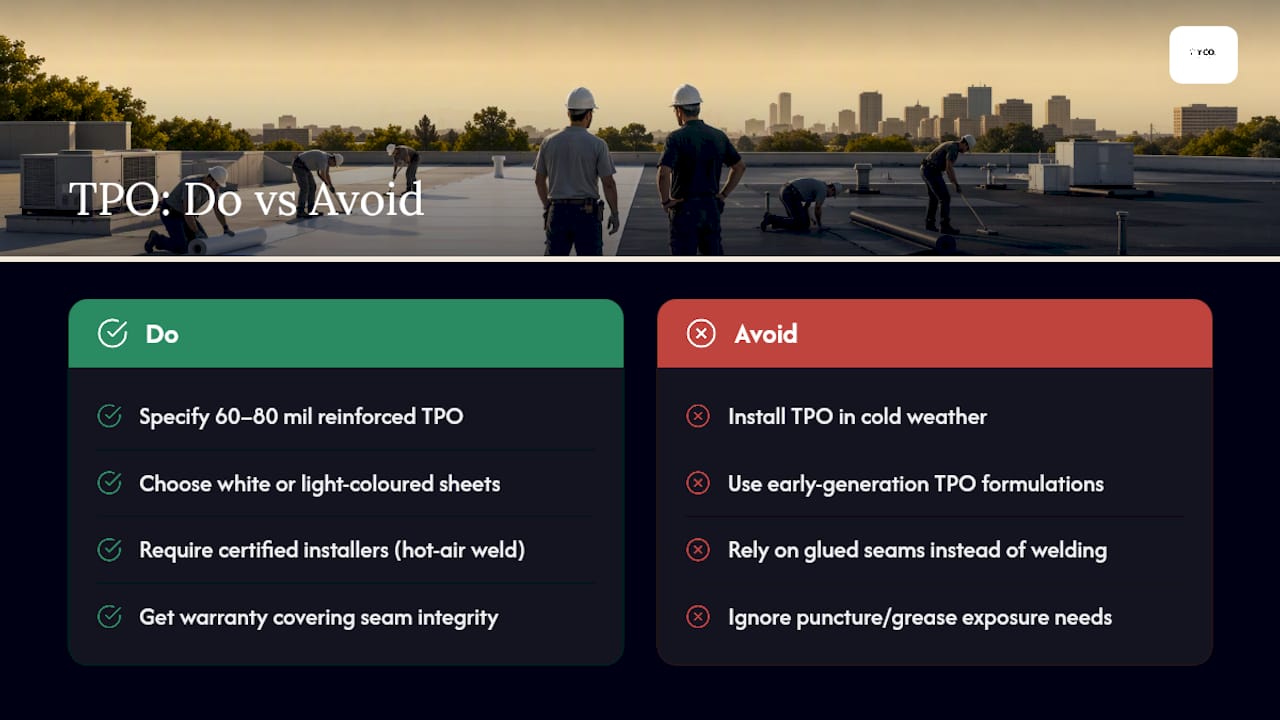
Most commercial-grade TPO comes in 45 to 80 mil thicknesses, with white or light-coloured sheets delivering the solar reflectance that makes TPO attractive on cooling-dominated buildings. The IIBEC technical advisory on TPO performance notes that early-generation TPO formulations had real durability problems, but current 60 to 80 mil reinforced products perform substantially better, provided the installer is certified and the warranty covers seam integrity specifically.
Where TPO tends to shine: buildings with heavy air conditioning loads, roofs exposed to restaurant grease or solvents, and high foot-traffic areas where puncture resistance matters. Where it struggles: cold-weather installation, since the membrane stiffens and complex flashing details become harder to weld cleanly without stress points forming.
What is EPDM and where does it hold its own?
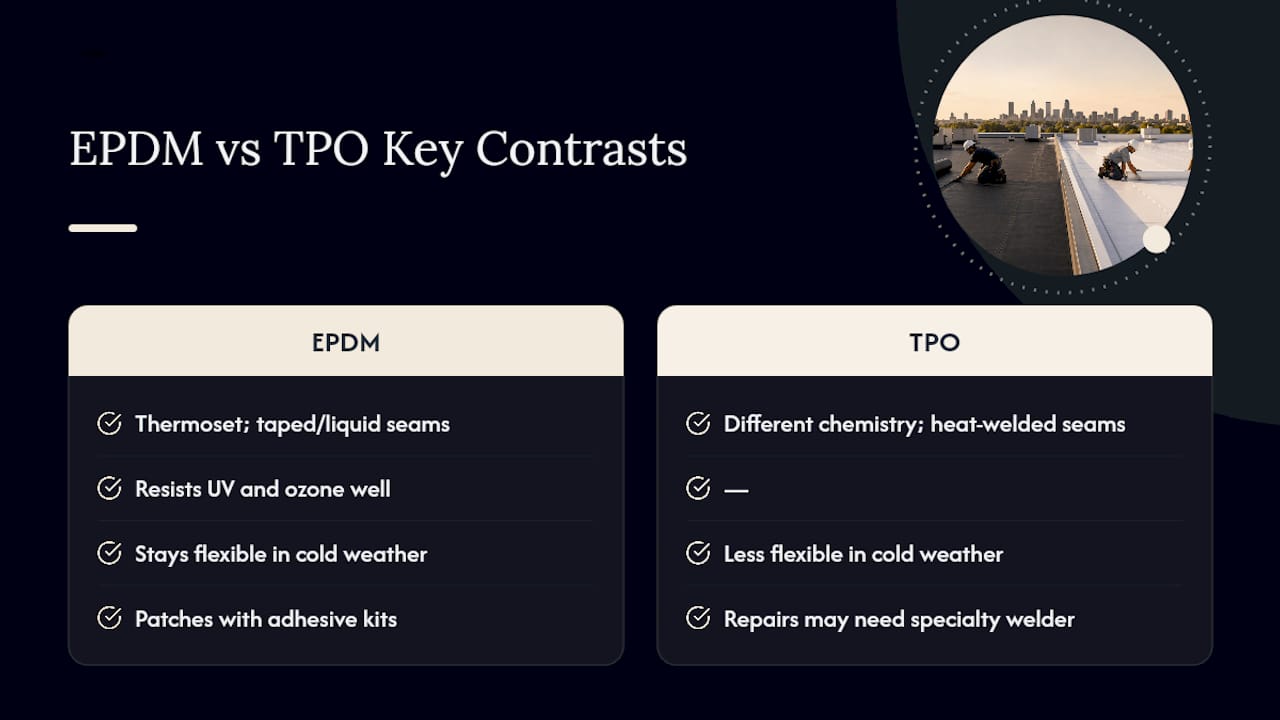
EPDM (ethylene propylene diene monomer) is a synthetic rubber membrane, and its chemistry is fundamentally different from TPO's. It's a thermoset material, which is why seams rely on adhesive tape or liquid adhesive rather than heat welding, a distinction that shapes both installation and long-term maintenance.
EPDM's biggest selling point is its track record. Fully vulcanized EPDM sheets, commonly sold in 45, 60, and 90 mil grades, resist UV and ozone degradation well enough that manufacturer datasheets back multi-decade service claims for properly installed systems. It also stays flexible in cold weather far better than TPO, which is why it's the default choice across much of Canada's colder regions.
Repairs are simpler too. A punctured EPDM membrane can usually be patched with an adhesive kit rather than a specialty welder, which lowers the bar for routine maintenance. The trade-off is ongoing seam vigilance. Taped seams age differently than the membrane field itself, and that's where most EPDM failures start. EPDM makes the most sense on simple roof shapes, hail-prone areas, and projects where first cost matters more than incremental energy savings.
Cost of TPO roofing vs cost of EPDM roofing over time
Installed pricing for TPO and EPDM overlaps more than most owners expect. What actually drives the number is insulation thickness, attachment method (mechanically fastened, ballasted, or fully adhered), and membrane thickness, not the base material choice itself.
The lifecycle math is where the real decision lives. EPDM often costs less upfront, but that gap can disappear once seam maintenance and higher cooling bills on black membranes are factored in, unless you specify a white-coated EPDM. TPO's reflective surface pays back faster on buildings with high cooling loads, while EPDM's simpler seam-free field (outside the taped joints) pays back through lower maintenance frequency on roofs that see little foot traffic.
Warranty terms matter as much as either factor. Read what's excluded, especially ponding water clauses, before comparing two bids on price alone.
Installation, inspection, and common roof repairs
TPO's heat-welded seams need dry conditions and a minimum working temperature. Below that threshold, welds don't fuse properly, and that's when installers reach for prefabricated corner and penetration details instead of field-forming the membrane, since field welding around tight geometry in the cold is where micro-cracking tends to start. EPDM's taped seams are less temperature-sensitive during installation but demand a clean, primed surface to bond properly.
A basic inspection checklist should cover:
- Seam condition, looking for lifting, gaps, or discoloration along weld or tape lines
- Flashing details at parapets, drains, and penetrations
- Ponding water that sits longer than 48 hours after rain
- Mechanical anchor points for looseness or corrosion
- Membrane surface for cracking, blistering, or granule loss
- Evidence of prior patch repairs and their current condition
Most repairs on either system are localized: a re-welded seam section on TPO, an adhesive patch on EPDM. Call a certified commercial roofer when you see widespread seam failure or ponding that's grown over multiple seasons rather than a single storm.
Pro Tip: Ask any bidding contractor for their membrane's exact mil thickness and SRI (solar reflectance index) rating in writing, not just a verbal "premium grade" claim. Under-thickness membranes are the most common corner cut on commercial re-roofs.
How do you choose between TPO and EPDM for your building?
Start with four variables: your climate, your building's cooling load, your roof's geometry, and how long you plan to own the property.
- If cooling costs are a significant operating expense, weight your decision toward TPO's reflectivity.
- If your building sits in a cold or hail-prone region with a simple, open roof deck, EPDM's flexibility and repairability usually win.
- If your roof has heavy foot traffic or grease exposure from rooftop equipment, TPO's puncture and chemical resistance matter more.
- If your ownership horizon is short, weigh first cost more heavily than lifecycle savings.
When comparing bids, ask contractors for membrane thickness in mils, published SRI figures, proof of certified welding or installation training, and the specific ponding water language in the warranty. Red flags include vague "commercial grade" descriptions with no mil number attached, no certified installer documentation, and warranties that don't mention ponding exclusions at all. Those gaps tend to show up as leaks within the first five years.
How roof choices fit into a full renovation plan
Roofing decisions rarely happen in isolation on a renovation project. When we're planning a full-home renovation or a second-storey addition, the roof membrane choice has to align with permitting timelines, structural sequencing, and how the rest of the building envelope performs. Having Cory Yefet as a single point of contact throughout that process means the roofing decision doesn't get made in a vacuum by a subcontractor who never sees the mechanical or insulation plans. Envelope choices made early tend to save owners from costly rework later.
— Cory
Standards and datasheets worth reading before you sign
Check ASTM D4637 for EPDM and ASTM D6878 for TPO testing standards, review the IIBEC advisory on TPO service life, and read the full warranty text, not just the marketing summary, before choosing a membrane.
Sources
- IIBEC technical advisory no. 012 — TPO single-ply performance and service life
- Flat Roof Report — TPO vs EPDM comparison
- Roofs
- JM EPDM NR 90 mil data sheet
FAQ
Is TPO roofing better than EPDM?
Neither is universally better. TPO tends to perform better on cooling-dominated buildings thanks to its reflective surface, while EPDM tends to hold up better in cold climates and on simple, low-traffic roofs where long-term flexibility and easy repairs matter most.
How do you tell if a roof is TPO or EPDM?
TPO is usually white, grey, or tan with visible heat-welded seam lines that look fused and continuous. EPDM is typically black (though white-coated versions exist) with distinct taped or adhesive seam strips running between sheets.
What are the downsides of EPDM roofing?
EPDM's taped seams require more ongoing inspection and maintenance than TPO's welded seams, since seam failure is where most EPDM problems start. Black EPDM also absorbs more heat than reflective TPO, which can raise cooling costs unless you specify a white-coated version.
Is EPDM more expensive than TPO?
Installed costs for TPO and EPDM overlap significantly, with the final price driven more by insulation, attachment method, and membrane thickness than by material choice alone. EPDM often has a lower first cost, but that gap can narrow or reverse once seam maintenance and energy costs are factored into the roof's full service life.