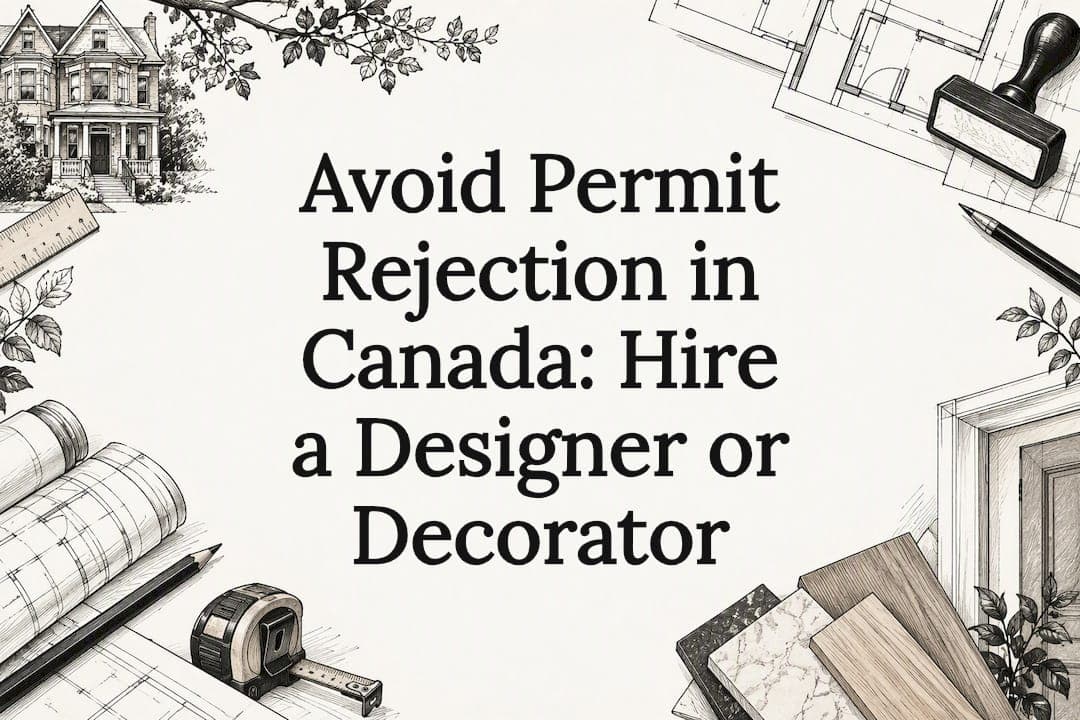
An interior designer handles technical, permit level work and structural planning, while a decorator focuses on finishes, furnishings and styling. Hire a designer for renovations that move plumbing, electrical or walls, and a decorator for a cosmetic refresh. Credentials and permit rules differ across Canada, so matching the professional to the scope protects your budget and your timeline.
TL;DR:
- Interior designers produce permit-ready technical drawings for structural changes, plumbing relocations, and load-bearing wall removals, which decorators cannot legally handle.
- Credentials and permit requirements vary across provinces, with only registered interior designers able to submit sealed drawings for permits in regions like Ontario.
- For purely cosmetic projects such as furniture and paint updates, decorators are faster and less costly because they do not handle structural or code compliance work.
- Hybrid projects benefit from sequential hiring, where designers handle permit drawings and structural coordination first, followed by decorators completing styling and finishing.
- Full-home renovations often require an integrated approach, with a single team managing design, permits, construction, and finishes to avoid delays and miscommunication.
Table of Contents
- What interior designers do: responsibilities, deliverables and examples
- What interior decorators do: scope, outputs and when they fit
- Education, credentials and legal differences across Canada
- When to hire which: a practical checklist
- Cost and pricing expectations for each role
- How designers and decorators can work together
- How Y&CO Build approaches design, permits and renovation coordination
- Career prospects and salary expectations for designers and decorators
- Common misconceptions about designers and decorators
- Typical project timelines for designers vs decorators
- Practical perspective: focus on scope over titles
- Contact Y&CO Build for full-home renovations and design coordination
- FAQ
- Sources
What interior designers do: responsibilities, deliverables and examples
Interior designers handle the technical backbone of a renovation: spatial planning, egress and accessibility requirements, structural coordination and code compliance. Their training covers how a space functions, not just how it looks, which is why Interior Designers of Canada describes the profession as a systematic process grounded in education, experience and examination, built to protect occupant health, safety and welfare rather than decoration alone.
A designer's paperwork reflects that technical load. Typical deliverables include:
- Schematic floor plans showing room layout, traffic flow and furniture zones.
- Construction drawings detailed enough for a permit application and for trades to build from.
- Material and finish specifications bundled into tender documents for contractor pricing.
- Coordination notes that align the drawings with engineers, architects and site contractors.
A kitchen renovation that relocates plumbing, a project that removes a load bearing wall, or a full-home gut renovation all sit squarely in designer territory. On those jobs, a designer typically works alongside a structural engineer and the contractor, translating code requirements into drawings the building department will actually approve.
What interior decorators do: scope, outputs and when they fit
Decorators work on the layer of a home you touch and see every day: furniture, lighting, textiles, paint, accessories and the overall look of a finished room. They are not trained or licensed to alter structure, plumbing or electrical systems, and a reputable decorator will say so upfront rather than overstepping.
Common decorator outputs include:
- Mood boards and concept presentations that establish a room's direction.
- Shopping lists and sourcing for furniture, fabrics, art and accessories.
- Full styling and installation once pieces arrive, including furniture placement and staging.
- Project coordination with painters, upholsterers and movers for a single room or a few rooms.
A decorator is the efficient choice for a living room refresh, a home staged for sale, a nursery makeover, or any project where the walls, wiring and plumbing stay exactly where they are.
Education, credentials and legal differences across Canada
The line between the two titles is not just professional preference, it is sometimes a legal one. In Ontario, the title "interior designer" is protected: only Registered Members of ARIDO may use it, after completing recognized education, supervised work experience, and the NCIDQ examination administered by CIDQ. A decorator can be talented and experienced without holding any of that, because decorating has never required a licence.
Provincial rules vary. Alberta recognizes "Licensed Interior Designer" under its Architects Act, a different statute with its own scope of permitted work, so a credential that means one thing in Ontario does not automatically transfer elsewhere.
Permit paperwork makes the distinction concrete. In Toronto, building permit guidance requires drawings for interior alterations to carry the qualified designer's name, registration number and a signed statement of responsibility. A decorator cannot fill that role, and submitting drawings without a registered designer attached commonly leads to rejected applications or requests for additional sealed documents.
Checking credentials before hiring is not a formality:
- Ask whether the professional is a Registered Member of their provincial association.
- Ask whether they can produce a Schedule 1 designer information form for permit drawings.
- Confirm they carry professional liability coverage appropriate to technical design work.
When to hire which: a practical checklist
Match the hire to the scope before you fall in love with a portfolio. Run through this order:
- List every physical change your project requires. Moving a wall, relocating a sink, adding a circuit or changing window openings all point to a registered interior designer.
- Check whether a permit is required. If the municipality needs sealed drawings, you need someone legally entitled to produce them, not a decorator.
- If the project is purely cosmetic, new furniture, paint, lighting fixtures, window treatments, a decorator can likely handle the entire job alone.
- For hybrid projects, bring in the designer first for permit drawings and structural coordination, then layer in a decorator for final styling once construction wraps.
- In your first meeting, ask directly: have you pulled permits in this municipality, can I see sample construction drawings, how do you charge, can you provide references from a similar project, and how do you handle furniture or material procurement.
Pro Tip: Bring your municipal permit requirements to the first meeting. A professional who can speak fluently about your specific permit process is usually the one qualified to handle it.
Cost and pricing expectations for each role
Fees scale with technical complexity, so decorators and designers rarely land in the same bracket unless a decorator is managing heavy procurement.
| Professional | Common fee models | Typical range |
|---|---|---|
| Decorator | Hourly, per-room flat fee, procurement markup | $50 to $500 per hour depending on experience level, with markups of 17% to 45% on sourced goods |
| Interior designer | Hourly, percentage of construction cost, fixed project fee | Varies by project complexity and region, often higher than decorator rates due to technical drawings and permit responsibility |
On a renovation budget overall, material costs typically run 30% to 40% of total project spend, with contractor fees commonly adding another 10% to 20%. That split matters when comparing proposals.
- Confirm whether permit drawings, revisions and site visits are included or billed separately.
- Ask whether procurement markups are disclosed as a percentage or folded quietly into item prices.
- Watch for a decorator's quote that creeps toward designer-level fees once project management is added in, since scope drives cost more than title does.
How designers and decorators can work together
Many successful renovations use both professionals in sequence rather than picking one. The designer leads the permit phase: structural drawings, code compliance, mechanical coordination with the contractor and engineer. Once construction is substantially complete, the decorator steps in for finishes, furniture and styling, working from the same floor plans so nothing contradicts the approved drawings.
Shared documentation prevents the most common failure point: a decorator ordering furniture sized for a room the designer later resized. A single, current floor plan and a joint site visit at handover closes that gap.
- Define upfront who manages procurement so orders are not duplicated.
- Set one point of contact for contractor questions during the overlap period.
- Hold a walkthrough before final installation to confirm finishes match the approved construction drawings.
Pro Tip: Ask your contractor to host the handover walkthrough between designer and decorator. A neutral party who already knows the site tends to catch gaps faster than either specialist alone.
How Y&CO Build approaches design, permits and renovation coordination
On full-home renovations, we work as the single point of contact rather than leaving homeowners to manage a designer, an engineer and a decorator separately. Cory Yefet stays involved from the feasibility study through final completion, coordinating permit drawings, trades and finish selections so decisions flow through one accountable person instead of getting lost between specialists.
We run every project through a structured eight-stage process, which keeps budget, permits and design coordination visible at each step rather than surfacing problems after the fact. That structure is what lets us preserve a home's character while updating cramped or outdated layouts without the miscommunication that often comes from hiring disconnected specialists one at a time.
Career prospects and salary expectations for designers and decorators
Career paths diverge almost as sharply as the day-to-day work. Interior designers typically build toward licensure through the "Three Es", education, supervised experience and the NCIDQ examination, which opens doors to commercial projects, permit-stamped residential work and eventual registered status with a body like IDC. That credential path tends to support higher and more stable billing rates over a career, since clients and contractors are paying for liability coverage and permit-ready documentation, not just an aesthetic sense.
Decorators follow a more flexible, less regulated path. Many build a client base through portfolio work, staging projects or retail and showroom experience, without a mandatory licensing exam standing between them and paid work. That flexibility can mean faster entry into the field, but it also means income varies widely by reputation, market and how much procurement work a decorator takes on. A decorator who manages substantial furniture and material sourcing often charges closer to designer rates because the markup on goods, not just the hourly rate, becomes the bulk of their revenue.
Neither path guarantees a particular income level, and public salary data for either role is not standardized across provinces, so broad claims about typical earnings are hard to verify. What is consistent is that the designers earning premium fees tend to be the ones holding registered status and taking on technically complex, permit-heavy projects, while decorators who build strong styling portfolios and repeat clients can sustain steady work without ever pursuing a licence.

Common misconceptions about designers and decorators
The biggest misconception is that the two titles are interchangeable, just a matter of regional preference in wording. They are not interchangeable where title protection applies, and treating them as synonyms is how homeowners end up with a decorator attempting permit drawings a municipality will not accept.
A second misconception: that hiring a designer always costs more and takes longer than a decorator for any project. That is only true when the project actually needs technical drawings. For a purely cosmetic refresh, a designer's technical training adds no value and a decorator will typically finish the job faster and at lower cost.
A third misconception assumes decorators only pick paint colours and throw pillows. Many decorators manage full procurement, installation schedules and multi-room styling projects that require real project management skill, even without structural authority.
Finally, some homeowners assume a general contractor automatically provides design services, or that a designer automatically manages construction. In practice, design and construction are separate skill sets. The strongest outcomes tend to come from a contractor who actively coordinates with whichever designer or decorator the project needs, rather than treating design as an afterthought bolted onto the build.

Typical project timelines for designers vs decorators
Decorator-led projects move quickly because there is no permit queue to wait through. A single room refresh, new furniture, paint, lighting and styling, often completes in a few weeks once selections are finalized, with the bulk of the wait tied to furniture lead times rather than labour.
Designer-led projects run longer by necessity. Permit review alone can add weeks depending on the municipality and how complete the submitted drawings are, and incomplete or improperly prepared permit drawings are a common cause of delay. Add construction time for structural work, plumbing and electrical relocation, and a full kitchen or whole-home renovation typically spans months rather than weeks from design through completion.
Hybrid projects land in between, and the sequencing matters: permit drawings and structural work need to be finalized before a decorator finalizes furniture dimensions, since resized rooms or relocated outlets can force a costly reorder. Building in that buffer between design handoff and decorator start is one of the simplest ways to keep a hybrid timeline realistic.
Practical perspective: focus on scope over titles
Before you fall for a style, check the scope. Confirm permit needs and technical requirements first, verify credentials and past project types, then worry about aesthetics. Titles mislead far more often than a clear project checklist does.
— Cory
Contact Y&CO Build for full-home renovations and design coordination
When your project needs both permit-level design work and construction expertise, having one accountable team removes the back-and-forth between separate specialists. We handle full-home renovations and additions across Toronto, coordinating designers, engineers and trades under a single point of contact from feasibility through completion.
Depending on your project, we typically take on:
- Full-home renovations that involve layout, plumbing, electrical and finishes together.
- Rear additions and full second-storey additions that require permit drawings and structural coordination.
- Combined rear and second-storey additions for homeowners adding significant square footage.
Readers comparing design-build approaches outside the GTA may also find NG Construction a useful reference for how integrated design-build teams operate in other markets. If you are ready to discuss your own project, reach out to our team and we will walk through scope, permits and budget together from the start.
FAQ
What are the red flags when hiring a decorator?
Be cautious of a decorator who offers to produce permit drawings, move plumbing or alter walls, since that work legally requires a registered interior designer in most provinces. Also watch for vague procurement markups and no written scope of work, which make it hard to compare proposals fairly.
What is the 3-5-7 rule in interior design?
Definitions vary across sources, and no single authoritative version appears in the material we rely on here. A commonly cited version relates to grouping decorative objects in odd numbers for visual balance, but treat it as a styling guideline rather than a technical standard.
Is AI replacing interior decorators?
There is no evidence in available industry data showing AI tools replacing decorators outright. AI-generated mood boards and design suggestions are increasingly used as a starting point, but final sourcing, styling and installation still rely on a decorator's judgment and relationships with suppliers.
Do interior decorators make a lot of money?
Earnings vary widely by market, reputation and how much procurement work a decorator manages, with hourly rates commonly ranging from $50 to $500 depending on experience level. There is no standardized salary figure across the profession, since decorating is not licensed or regulated the way interior design is in provinces like Ontario.
Sources
- Credentials matter | ARIDO
- Interior design 101 | Interior Designers of Canada (IDC)
- Interior decorator cost | HomeStars
- Interior alterations – City of Toronto