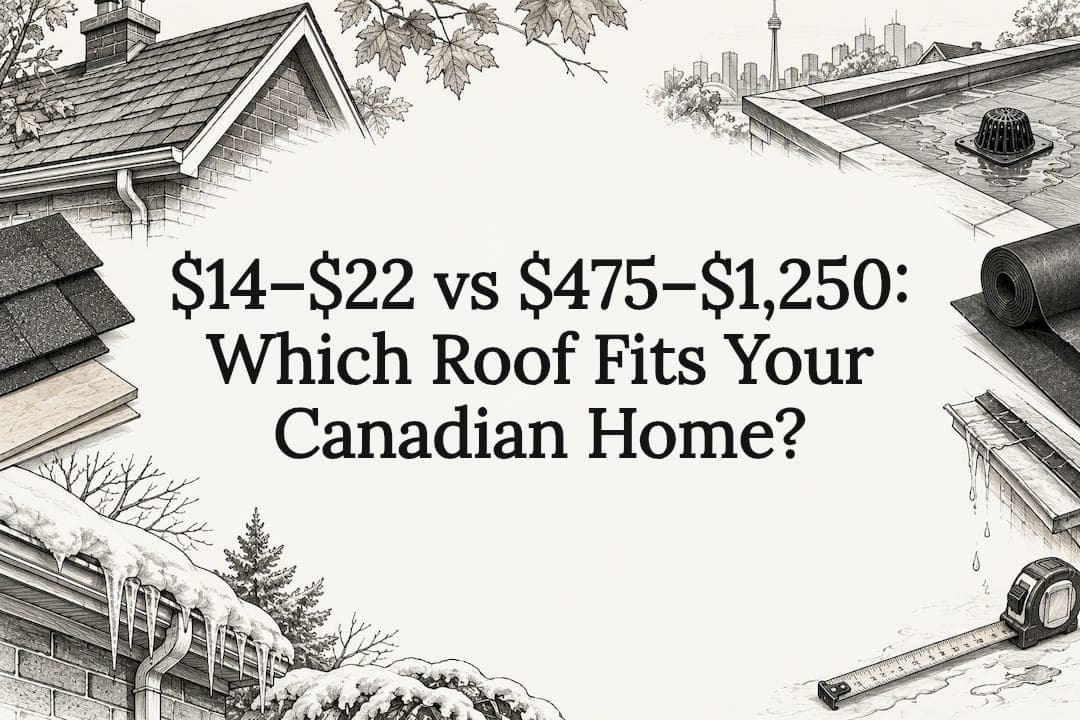
If low upfront cost and usable rooftop space top your list, a well-detailed flat roof, built with a membrane like EPDM, usually wins. If you want the longest service life and effortless snow shedding, a pitched roof with architectural asphalt shingles usually wins. Membrane choice, drainage, insulation, and contractor attention to detailing matter as much as the shape itself.
TL;DR:
- Flat roofs typically cost $14 to $22 per square foot to install and offer lower initial costs but require more frequent maintenance, especially around drains.
- Pitched roofs cost between $475 and $1,250 per square and generally last longer, with 25 to 50 years for asphalt shingles, and shed snow automatically for better durability.
- Snow accumulation and ice dams pose significant risks for flat and pitched roofs respectively, requiring engineered drainage for flat roofs and proper insulation and ventilation to prevent ice dams in pitched roofs.
- Roofing material choice and installation details, such as seam methods and drainage design, influence lifespan more than shape alone; good detailing can extend a roof’s life from 15 to over 40 years.
- For new or upgraded roofs, get detailed quotes that specify membrane type, seam method, drain count, and warranty, especially when roof planning is part of a broader renovation or addition.
Table of Contents
- Flat vs pitched roof: a quick side-by-side comparison
- Pros and cons of flat and pitched roofs
- Installed cost ranges and expected service life by material
- How flat membranes and pitched systems are actually built
- Snow, ice dams, and drainage: the engineering side of the decision
- Maintenance checklist and common repairs
- How to choose: a decision checklist and contractor questions
- Design and resale: how roof shape shows up in your home's value
- Y&CO Build's approach to roofed additions and renovations
- The real lesson: detailing beats trend
- Planning a roof change as part of a bigger renovation?
- Sources
- FAQ
Flat vs pitched roof: a quick side-by-side comparison
The two shapes solve different problems, and the fastest way to see that is to line them up on the numbers that actually affect your budget and your headaches down the road.
| Factor | Flat roof | Pitched roof |
|---|---|---|
| Typical installed cost | $14–$22 per sq ft (TPO/mod-bit) | $475–$1,250 per square (3-tab to premium shingle) |
| Expected lifespan | 15–30 years, membrane dependent | 25–50 years for asphalt shingles |
| Best for | Additions, modern extensions, rooftop decks or solar | Long-term ownership, heavy snow regions, traditional streetscapes |
| Maintenance intensity | Higher, regular seam and drain checks | Lower, periodic inspection and flashing checks |
| Common materials | EPDM, TPO, PVC, modified bitumen | Asphalt shingles, standing seam steel, cedar, tile |
Cost figures come from a 2026 Canadian roofing price guide, and pricing units differ between the two shapes: flat roofs are usually quoted per square foot, sloped roofs per square (100 sq ft).
A few trade-offs matter more than the table lets on:
- Flat roofs tend to have lower initial installation costs but generally require more frequent maintenance on membranes, particularly near drains and penetrations.
- Pitched roofs naturally shed water and snow, contributing to longer lifespans with comparatively less maintenance.
- The cheapest flat membrane up front isn't always the cheapest option over 20 years once you factor in replacement cycles.
Pros and cons of flat and pitched roofs
Every roof shape trades one advantage for another. Here's what that trade actually looks like once you own the house.
Flat roof advantages:
- Usable rooftop space for a deck, green roof, or solar array, particularly valuable on urban lots with small yards.
- Simpler framing, which often lowers structural costs on additions.
- A clean, modern look that suits contemporary extensions and infill builds.
Flat roof drawbacks:
- Ponding water is the number one enemy, and it happens fast if slope and drains aren't detailed correctly.
- Seams and flashing details carry more risk of failure than a continuous shingle field.
- Membranes generally need re-coating, patching, or seam repair more often than a shingle roof needs attention.
Pitched roof advantages:
- Gravity does the drainage work, so water and snow move off the surface without relying on mechanical drains.
- Many pitched materials, especially architectural asphalt shingles, standing seam steel, and cedar, outlast typical flat membranes.
- Attic space allows for ventilation that helps regulate temperature and moisture year round.
Pitched roof drawbacks:
- Higher upfront material and labour costs, particularly with steep or complex rooflines.
- Little to no usable rooftop space, so solar or deck plans usually move to the ground or a flat-roofed portion of the house.
A rear addition on a semi-detached home is a classic candidate for a flat roof, since it keeps the new structure lower than the existing roofline and opens up deck potential. A century-old bungalow with a steep gable, on the other hand, almost always calls for a pitched replacement to match the street.
Installed cost ranges and expected service life by material
Sticker price tells you almost nothing about value. A $475 per square 3-tab shingle roof and a $1,250 per square premium architectural shingle roof can end up costing about the same per year of service, once you divide price by expected lifespan.
| Material | Installed cost | Expected lifespan |
|---|---|---|
| 3-tab asphalt shingles | $475/square | ~15–20 years |
| Architectural asphalt shingles | $475–$575/square | 25–30 years |
| Premium/designer shingles | $1,250/square | Up to 50 years |
| Standing-seam steel | Higher per square, varies by profile | 40–60+ years |
| Cedar shakes | Premium pricing, regional variation | 25–30 years |
| TPO membrane | $1,250/square equivalent | 15–20 years |
| EPDM membrane | $475–$700/square equivalent | 25–30 years |
| Modified bitumen | generally mid-range in cost among membranes | typically lasts roughly 15 to 25 years |
Those installed price ranges assume a straightforward tear-off. A few things push costs above the low end: full tear-off versus overlay, added insulation to meet current energy targets, steep or cut-up rooflines that increase the slope factor, and regional labour rates that shift depending on where in Ontario you're building. HST applies on top of every quote, so ask whether the number you're seeing already includes it.
Quick cost-of-ownership example: Over a 20-year horizon, a $9,000 architectural shingle roof (30 year lifespan) needs zero replacements in that window. A $7,500 modified bitumen flat roof (18-year average lifespan) likely needs a second install partway through, pushing lifetime cost past the shingle option even though the sticker price looked lower on day one.

EPDM and PVC flat membranes commonly reach 25 to 30 years with good detailing, while modified bitumen tends to land in the 15 to 25 year range, so the membrane you choose changes your replacement math more than almost any other decision.
How flat membranes and pitched systems are actually built
The material name on a quote tells you less than the installation method behind it. Two roofs using the same membrane can perform completely differently based on how the seams and attachment were done.
Flat roof systems rely on a handful of core techniques:
- Heat-welded seams (TPO, PVC) create a continuous, strong bond, but the process is sensitive to wind and cold, which is why winter installs need extra care.
- Tape-seamed EPDM allows installation in colder conditions than heat-welded systems, a real advantage for late-season projects in this climate.
- Torch-on modified bitumen uses heat to fuse layers, a method that has decades of track record but demands a skilled hand near flashings.
- Attachment methods, fully adhered, mechanically fastened, or ballasted, affect wind uplift resistance and should match your roof's exposure and height.
Pitched roofs depend on layers you never see once shingles go down: synthetic underlayment (increasingly preferred over old-style felt), ice-and-water shield at eaves and valleys, proper flashing at every penetration, and attic ventilation that keeps the roof deck temperature consistent.
If you're planning a rooftop deck or future solar array, that decision needs to shape membrane choice from day one. PVC generally handles rooftop traffic and equipment loads better than a standard EPDM install, while a pitched roof rules out most rooftop use entirely, aside from a shed dormer or flat section built specifically for it.
Snow, ice dams, and drainage: the engineering side of the decision
Snow doesn't treat every roof shape equally, and that's where a lot of homeowners get surprised after their first winter.
Flat roofs need engineered drainage, not hope. NRC guidance calls out unbalanced drifts and longer snow residence time on low-slope roofs as structural design factors, particularly near parapets, mechanical units, and adjacent taller walls where snow piles up unevenly. A perfectly flat surface is actually a design flaw. Roofs need a minimum practical slope, often around a quarter inch per foot, achieved through tapered insulation rather than structural framing changes, since tapered insulation is typically cheaper than re-sloping the deck itself.

Pitched roofs face a different enemy: ice dams. These form when heat escapes into the attic, melts snow on the upper roof, and refreezes at the colder eaves, backing water up under shingles. The fix isn't a heating cable alone. It's attic insulation, ventilation, and air-sealing working together to keep the whole roof deck at a consistent, cold temperature, according to Insurance Bureau of Canada guidance.
Pro Tip: Don't let anyone shovel a flat membrane roof by hand after a heavy snowfall. Ice picks and shovel edges puncture EPDM and TPO more often than people expect. If snow load becomes a concern, call a roofing crew with roof rakes and soft-edged tools, not the same crew clearing your driveway.
Maintenance checklist and common repairs
A roof that gets checked twice a year rarely fails without warning. One that gets ignored usually fails at the worst possible moment.
- Spring inspection: check flat roof drains and scuppers for debris, and scan pitched roofs for shingles lifted or lost over winter.
- After major storms: walk the perimeter looking for blown-off shingles, lifted flashing, or standing water on flat sections more than 48 hours after rain.
- Fall inspection: clear gutters and drains before freeze-up, and confirm attic ventilation isn't blocked by insulation before the heating season starts.
Common warning signs differ by shape. On flat roofs, watch for membrane seam separation, ponding that doesn't drain within two days, and flashing pulling away at parapets. On pitched roofs, watch for granule loss in gutters, curling or cracked shingles, and rusted step flashing at chimneys or dormers.
Small issues, an open seam, a cracked flashing joint, are usually worth patching. But when ponding is chronic, or shingles are failing across large sections rather than isolated spots, patching becomes a losing game and full replacement is the more honest answer. On winter maintenance, Tarion advises against salt or chemical de-icers on asphalt shingles, since they accelerate deterioration, and against shovelling membranes directly for the same reason mentioned above.
How to choose: a decision checklist and contractor questions
Everything above boils down to a handful of questions you need answered before signing anything.
Start with your own priorities:
- How long do you plan to own the home? A 5 year horizon changes the math versus a forever home.
- Do you want rooftop use for a deck, garden, or solar in the next decade?
- What's your roof's structural capacity for added weight, insulation, or equipment?
- How exposed is your site to wind, snow drift, or heavy tree cover?
- What warranty coverage do you actually expect, manufacturer, labour, or both?
When you get quotes, push contractors on specifics rather than accepting a one-line scope:
- Ask for the exact membrane spec (EPDM, TPO, PVC, or modified bitumen) and seam method.
- Ask what slope or tapered insulation plan is included, and how many drains or scuppers the design calls for.
- Ask for the warranty in writing, not a verbal promise.
Pro Tip: A quote that doesn't mention insulation R-value, flashing detail, or drain count in writing is a quote you should ask more questions about. Vague scoping on a roof is exactly where budget overruns and callback leaks start.
Design and resale: how roof shape shows up in your home's value
Flat roofs suit modern architecture and open up rooftop possibilities buyers increasingly want, but for considerations about finishes and design options, see our plantation shutters comparison guide, although in a neighbourhood full of pitched heritage homes, a flat-roofed addition can narrow your eventual buyer pool. Pitched roofs, by contrast, tend to have broad appeal across most buyer types, and the material you choose signals quality: architectural shingles read as a solid, well-kept home, while standing seam steel or cedar signal a higher-end renovation.
If you expect to sell within five to ten years, match major roof decisions to what's already on your street. A striking flat-roofed addition might be the right architectural call and still be the wrong resale call in a traditional pocket of the city.
Y&CO Build's approach to roofed additions and renovations
On every project, Cory Yefet acts as the single point of contact from feasibility through completion, which cuts down the miscommunication that typically happens when architects, engineers, and roofers report to different people. That matters most on roof-heavy work: permitting, drainage detailing, and construction sequencing all need to line up before a single membrane goes down or a truss gets set. Projects like the Galley Avenue renovation show how roof changes get folded into a broader scope without surprises mid-build. Full permitting guidance lives on our addition permits and zoning page.
The real lesson: detailing beats trend
The flat versus pitched debate gets treated like a style choice, but the data says otherwise: drainage design, membrane selection, and attic ventilation decide whether a roof lasts 15 years or 40. Brief your contractor on tapered insulation and drain count before you pick a look, and always get itemised quotes with membrane warranties spelled out in writing. Check contractor references specifically for roof detailing, not just general renovation work, since that's where most failures actually start.
— Cory
Planning a roof change as part of a bigger renovation?
If your roof decision is tied to a rear addition, a second-storey build, or a full home renovation, the whole scope, permitting, engineering coordination, and construction can be managed through one accountable point of contact instead of juggling separate roofers, framers, and designers yourself.
If your roof job stands alone with no other renovation work involved, get two or three roofing-only quotes and compare them against the detailing questions covered above. But if you're planning a rear addition or second-storey addition where roof design, structural capacity, and drainage all need to work together from day one, that's exactly where an integrated approach pays off. An initial conversation often involves a site visit, a scope discussion, and early budget ranges before design begins. Start with a full-home renovation consultation to see how roof, layout, and budget fit together from the start.
Sources
- Homeowner
- National Research Council Canada — roof snow distributions and load guidance
- Insurance Bureau of Canada — stay protected: understanding and helping prevent ice dams
- How much does a new roof cost in 2026? Canada pricing guide
FAQ
Is a pitched roof better than a flat roof?
Neither shape is universally better. Pitched roofs generally last longer, 25 to 50 years for asphalt shingles, and shed snow on their own, while flat roofs cost less upfront and offer usable rooftop space that pitched roofs can't match.
What is the major disadvantage of using a flat roof?
Ponding water is the biggest risk. Without proper slope and enough drains, water sits on the surface for days, stresses the membrane, and eventually causes leaks around seams and flashing.
How much cheaper is a flat roof than a pitched roof?
Flat membrane roofs are typically quoted at $14 to $22 per square foot installed, while pitched asphalt shingle roofs run $475 to $1,250 per square depending on shingle grade. The comparison depends heavily on roof size and complexity, so get quotes in matching units before assuming one is cheaper.
What are the disadvantages of a pitched roof?
Pitched roofs cost more to install upfront and leave little to no usable rooftop space for decks or solar. Complex rooflines with multiple valleys and dormers also increase both material waste and labour time compared to a simpler design.
Can Y&CO Build handle roof changes as part of a renovation?
Yes. Y&CO Build manages roof-related work, drainage detailing, permitting, and structural coordination, as part of full-home renovations and additions in Toronto, with Cory Yefet as the single point of contact throughout the project.