A construction manager is the owner's advocate, hired to advise on cost, schedule and design before a single wall gets built. A general contractor is the builder, holding the trade contracts and delivering the finished project. Hire a CM early on complex, evolving-scope work; hire a GC once your drawings are set and the scope is defined.
TL;DR:
- A construction manager is most beneficial for complex, evolving scope projects when early cost, schedule, and design input can prevent costly redesigns and overruns.
- A general contractor is more suitable for well-defined projects with finished drawings that require straightforward execution and fixed-price contracts.
- Contract type and risk allocation, such as GMP or lump sum, significantly influence project transparency, scope control, and who bears construction-phase risk.
- Large, multi-phase or ongoing projects tend to favor a CMAR or CM at risk, while small renovations usually do not justify a separate CM.
- Homeowners should prioritize open-book cost transparency and ask potential hires about price ceilings and scope limits before signing any agreement.
Table of Contents
- Construction manager vs general contractor: what does a CM actually do?
- Construction manager vs general contractor: what does a GC actually do?
- Construction manager vs general contractor: how do the two compare directly?
- Contract types explained: what CMAR, GMP, and lump sum actually mean
- How do you choose the right delivery model for your project?
- How do you vet and hire the right person for the job?
- How does Y&CO Build apply construction management principles?
- What career paths and licensing lead to each role?
- What skills separate a strong CM from a strong GC?
- Where does each role typically work?
- What legal and regulatory differences apply to each role?
- Which project types suit a CM versus a GC?
- What conflicts of interest come up, and how are they managed?
- What actually matters when you're deciding
- How Ycobuild brings CM-level planning to your renovation
- Sources
- FAQ
Construction manager vs general contractor: what does a CM actually do?
A construction manager, often called a CM, works for the owner, not the trades. There are two flavours worth knowing. A CMa (agency CM) is a pure adviser: no construction risk, just guidance. A CMc, more commonly called CM at risk or CMAR, starts as an adviser during design, then converts into the builder under a guaranteed maximum price once the drawings firm up, as Epic Construction Management explains.
During preconstruction, a CM typically handles:
- Constructability reviews that catch design conflicts before they hit a job site
- Cost estimating at each design milestone, not just once at the end
- Schedule input that flags long lead-time items (custom windows, structural steel) early
- Value engineering to trim cost without gutting the design intent
The U.S. Bureau of Labor Statistics notes that CMs are often hired on fee-based arrangements and can meaningfully reduce cost overruns on complex work by getting involved before problems are locked into the drawings. Fee structures vary: fixed fee, a percentage of construction cost, or a monthly retainer. Industry guides commonly cite CM fees running from low single digits up into the mid teens, depending on scope and risk carried, per Angi's breakdown. A CM earns their keep on projects where the scope is still moving, the owner has never built before, or the design team needs a builder's eye at the table early.
Construction manager vs general contractor: what does a GC actually do?
A general contractor is the entity that signs contracts with subcontractors, procures materials, and runs the job site day to day. Once drawings are done (or close to it), the GC turns them into a finished building. That's the core distinction in any comparison of general contractor duties versus construction management responsibilities: a GC executes against a known scope; a CM shapes the scope before execution starts.
Typical GC responsibilities include:
- Soliciting and awarding subcontracts for framing, electrical, plumbing, and finishes
- Sequencing trades so work doesn't stall waiting on deliveries or inspections
- Supervising daily site activity, safety compliance, and quality control
- Managing change orders when field conditions differ from the drawings
GCs contract in a few common ways: lump sum (one fixed price for the whole scope), cost-plus (actual costs plus a fee), or GMP (a ceiling price with savings often shared). Vertex's guide for property owners notes that GCs typically hold the trade contracts directly and absorb construction-phase risk, which is precisely why lump sum contracts push cost certainty onto the builder rather than the owner. For a renovation or addition with a defined scope and completed drawings, a GC is usually the more efficient hire. GCs must carry proper licensing, liability insurance, and workers' compensation coverage, and they own on-site safety obligations for the duration of the build.
Construction manager vs general contractor: how do the two compare directly?
The practical differences show up in four places: when each one joins, who carries the contracts, how transparent the pricing is, and what scale of project each suits.
- Timing and reporting. A CM often joins during schematic design or even feasibility, reporting straight to the owner. A GC typically joins once drawings are largely finished, reporting to whoever holds the contract, which may be the owner directly or a CM at risk managing the build.
- Contract holder and risk. Under an agency CM (CMa), the owner signs trade contracts directly, and the CM never assumes construction-phase risk. Under a GC or CMAR arrangement, the builder holds the trade contracts and absorbs the risk of cost overruns once a lump sum or GMP is set, a point Vertex's owner-focused guide makes clear when comparing delivery models.
- Cost transparency. A CMa relationship is usually open-book: the owner sees every invoice. A lump sum GC contract trades that visibility for price certainty. You know the number up front, but you don't see the builder's actual margins.
- Project fit. Small, well-defined renovations rarely need a separate CM; a GC alone handles them efficiently. Large custom builds or projects with design still evolving benefit from a CM's early input, since the owner often recovers that fee through avoided change orders on complex work.
Pro Tip: Ask any candidate one direct question: "Is there a price ceiling on this project, and can I see the underlying costs?" The answer tells you immediately which delivery model you're actually being offered, no matter what title is on the business card.
Contract types explained: what CMAR, GMP, and lump sum actually mean
Every construction manager vs general contractor decision eventually comes down to which contract you sign, because the contract dictates who owns risk. Here's what the main forms actually mean in practice:
- CMa (agency CM): Pure advisory role. The owner holds all trade contracts; the CM never takes construction risk and is paid a fee for advice and oversight.
- CMc / CMAR (CM at risk): The manager advises during design, then signs a GMP and becomes financially responsible for delivering within that ceiling, as Epic Construction Management describes.
- Lump sum (GC): One fixed price for the defined scope. Simple to understand, but any scope changes trigger formal change orders.
- Cost-plus: The owner pays actual costs plus a set fee or percentage. Transparent, but the owner carries most of the cost-overrun risk.
- GMP: A ceiling price, often paired with open-book accounting during preconstruction, so the owner gets visibility early and cost certainty later, a hybrid several CMAR structures rely on.
Fee ranges vary by contract type and project size. GC fees commonly land in a 10 to 20% band depending on the contract form, while CM fees run lower on a percentage basis but scale with complexity, according to Angi's fee comparison. The CMAA and AIA contract families formally separate CMc from CMa, mapping distinct risk profiles to each, which is worth knowing if you're comparing sample agreements from different firms.
How do you choose the right delivery model for your project?
Match the model to the project, not the other way around. Run through these criteria before you sign anything:
- How complex is the scope? A kitchen remodel or single addition rarely justifies a separate CM. A full-home renovation with structural changes, mechanical upgrades, and a second-storey addition benefits from someone managing cost and coordination from day one.
- Are the drawings finished? If yes, a GC working from a lump sum or GMP contract is usually the cleaner path. If design is still evolving, a CM's early input prevents costly redesigns mid-build.
- How involved do you want to be? Open-book CM arrangements mean more visibility but more of your own time reviewing invoices. Lump sum GC contracts mean less oversight but less price flexibility.
- What's your risk appetite? If you want price certainty above all else, a GMP or lump sum contract shifts overrun risk to the builder. If you want maximum cost transparency, an agency CM keeps you closer to the numbers.
- Is schedule pressure a factor? CMAR structures can compress timelines by overlapping design and early construction packages, useful when you're racing a deadline.
For a straightforward renovation or single addition, a general contractor working under a defined scope is typically the appropriate and cost-effective choice, since adding a separate construction manager on top can simply duplicate overhead without adding value. For a complex custom build, ask candidates directly how they'd structure the contract, how they handle scope changes, and whether pricing stays open-book through construction.
How do you vet and hire the right person for the job?
Before signing anything, request a licence number, proof of liability insurance, and three recent references you can actually call. Ask pointed questions: how often have their projects gone over budget, how do they resolve disputes with subcontractors, and can they show a sample budget report from a comparable project?
- Request a certificate of insurance (COI) naming you as an additional insured
- Ask for a sample schedule and budget report from a past project of similar size
- Compare how each candidate handles change orders, not just their base price
Pro Tip: When comparing bids, normalize them against the same scope document first. A low number built on a thinner spec isn't actually cheaper, it's just missing line items you'll pay for later as change orders.
How does Y&CO Build apply construction management principles?
Some renovation firms structure full-home renovations around a single accountable point of contact, rather than splitting owner-facing duties across a separate CM and a construction crew. That single-contact model folds classic CM responsibilities, feasibility review, budget planning, and design coordination, directly into the build relationship.
- Preconstruction tasks (feasibility study, budget planning, permitting, designer coordination) happen before ground breaks
- Construction-phase tasks (scheduling, trade coordination, on-site supervision) run under the same accountable contact
- Cost management stays visible to the homeowner throughout, echoing the open-book transparency a CMa relationship typically offers
- The eight-stage renovation process maps each phase so owners know what happens when
This structure aims to reduce the miscommunication risk that shows up when preconstruction advice and on-site delivery sit with different companies.
What career paths and licensing lead to each role?
Construction managers typically build toward the role through a construction management or engineering degree, then move up through estimating, scheduling, or project coordination positions. Canada's National Occupational Classification groups construction managers under planning, organizing, and directing construction activities, alongside budget and schedule preparation, and lists several related job titles used across the industry, from project manager to construction superintendent.
General contractors often come up through the trades first, working as electricians, framers, or site supervisors before earning a contractor's licence and starting or joining a GC firm. Licensing requirements vary by province and municipality, and most jurisdictions require proof of insurance and a business licence before a contractor can legally bid work.
Certifications matter differently for each path. CMs often pursue credentials like the Certified Construction Manager (CCM) designation or a Project Management Professional (PMP) certification, both signalling formal training in scheduling, budgeting, and risk management. GCs lean more heavily on trade licensing, safety certifications (like fall protection or WHMIS training), and a proven track record of completed projects rather than academic credentials.
Neither path is strictly faster or more lucrative. CMs often earn steady fee income tied to project complexity, while GC income scales with volume and margin management across multiple jobs running simultaneously. Career switchers moving from trades into general contracting usually have an easier entry point than those trying to break into construction management without a project coordination background.
What skills separate a strong CM from a strong GC?
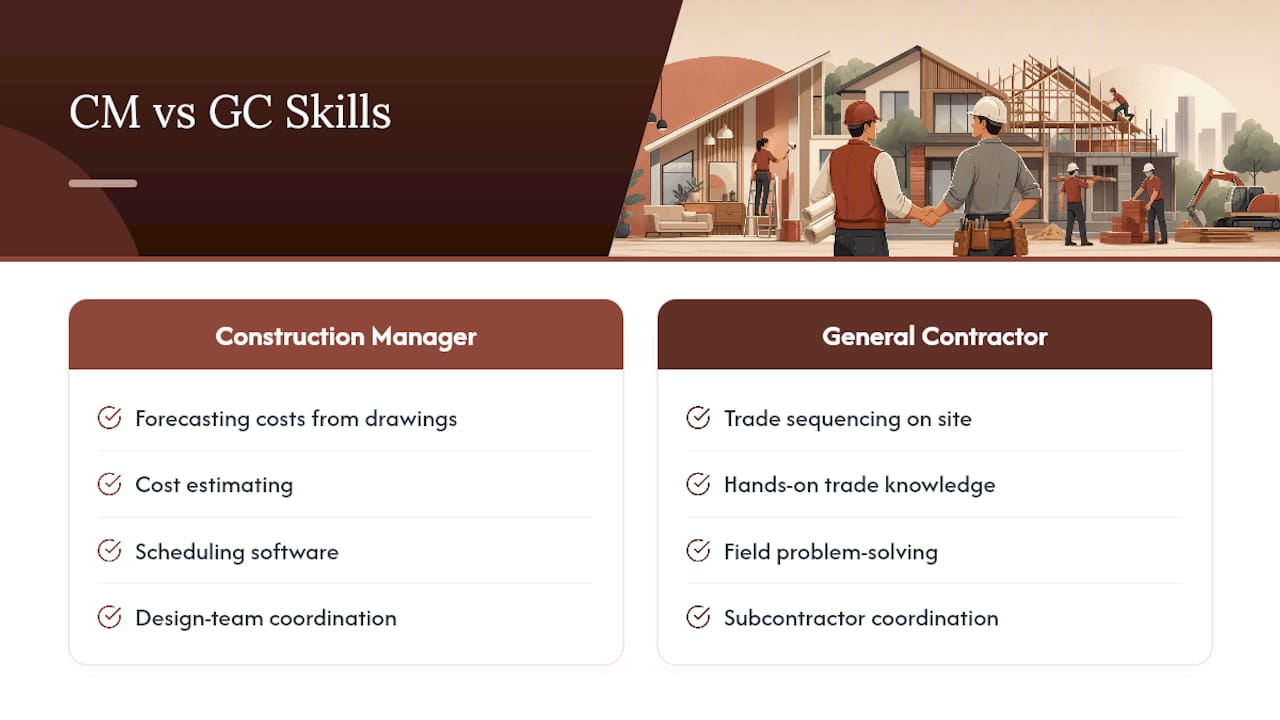
A construction manager's core skill is forecasting: reading incomplete drawings and predicting where costs will land before they're locked in. That means strong cost estimating ability, comfort with scheduling software, and the diplomatic skill to keep architects, engineers, and owners aligned during design, when nothing is built yet and disagreements are cheapest to resolve.
A general contractor's core skill is execution under pressure: keeping a dozen trades sequenced correctly while a job site throws daily surprises at them. That demands hands-on trade knowledge, quick problem-solving when field conditions don't match drawings, and the people skills to keep subcontractors showing up on schedule.
Both roles need financial literacy, but it's applied differently. A CM reads and explains open-book cost reports to an owner who's never seen a construction budget before. A GC manages margin across a lump sum or GMP contract, absorbing small cost surprises without passing every one back to the owner as a change order.
Communication style differs too. CMs spend more time translating technical decisions into plain language for owners during design meetings. GCs spend more time directing trades on-site and troubleshooting in real time. A homeowner interviewing candidates should listen for which mode a person defaults to. Someone who talks fluently about budgets and design trade-offs is thinking like a CM. Someone who talks fluently about sequencing and site logistics is thinking like a GC.
Where does each role typically work?
Construction managers are common on institutional, commercial, and large multi-family projects, where owners lack in-house construction expertise and need an advocate through a lengthy design process. They're employed by CM firms, engineering consultancies, or sometimes directly by large developers running their own capital projects.
General contractors dominate the residential and light commercial space: renovations, additions, custom homes, and small commercial buildouts. Most GC firms are smaller, owner-operated businesses running several jobs at once, rather than large consultancies with dedicated preconstruction departments.
The overlap happens on mid-sized custom residential projects, exactly where full-home renovations and additions in dense urban markets often sit. A complex renovation with structural changes, mechanical upgrades, and an addition can benefit from CM-style preconstruction planning, even when the entity delivering the work is structured as a single-contact GC relationship rather than a separate CMa firm.
What legal and regulatory differences apply to each role?
Licensing requirements attach to the general contractor, not typically to an agency construction manager. A GC needs a contractor's licence to legally bid and perform construction work, plus liability insurance and workers' compensation coverage for anyone on-site. An agency CM, since they don't perform construction work directly, may not need the same trade licensing, though many still carry professional liability insurance to cover advisory errors.
Contract law treats the two differently as well. A GC's lump sum or GMP contract is enforceable against a defined scope of work, meaning disputes typically centre on whether delivered work matches drawings and specifications. A CMa's agency agreement is more like a professional services contract, closer to what you'd sign with an architect or engineer, and disputes there tend to focus on the quality of advice given rather than physical construction defects.
Where a CMc or CMAR structure applies, the manager takes on GC-like contractual exposure once they sign the GMP, meaning they inherit both the advisory relationship and the construction-phase liability. That hybrid status is why CMAR contracts get more scrutiny from owners' lawyers than a straightforward agency CM agreement.
Which project types suit a CM versus a GC?
Large institutional builds, hospitals, schools, multiphase commercial developments, tend to bring in a construction manager early because the scope evolves across multiple design milestones and stakeholders. A CMAR structure often makes sense here: the owner gets early cost input, then locks in a GMP once design is far enough along to price accurately.
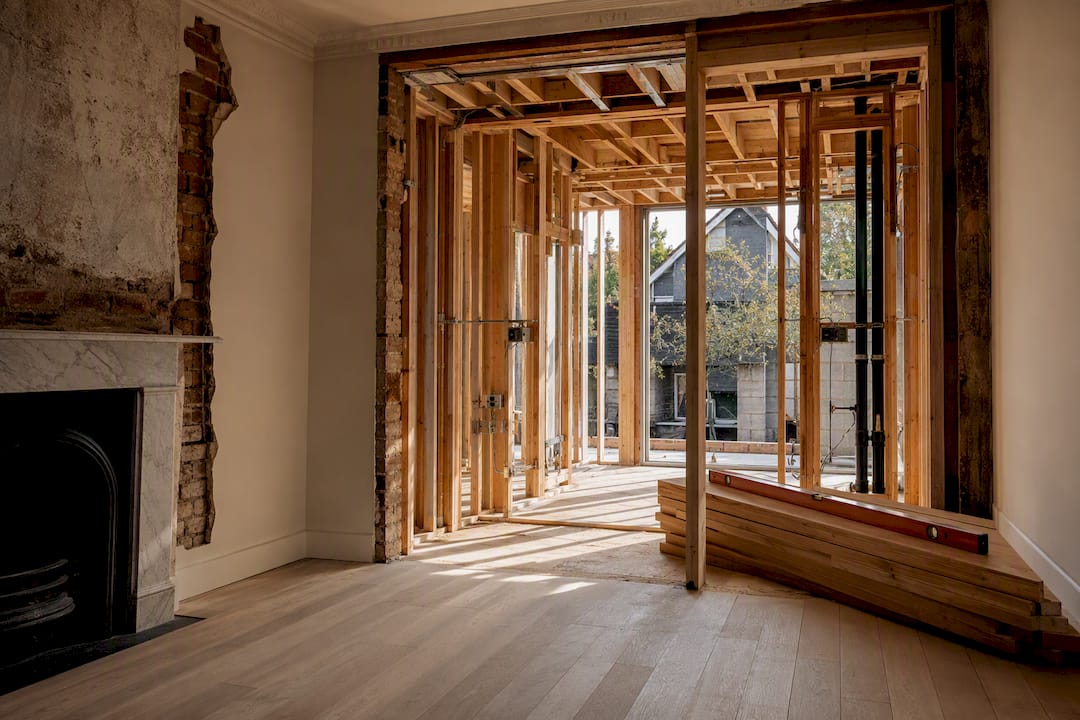
Full-home renovations with structural changes, mechanical system upgrades, and an addition sit in the middle ground. These projects have enough complexity to benefit from upfront feasibility and budget planning, but not so much scale that a separate CM firm is typically warranted.
Straightforward scopes, a kitchen remodel, a bathroom renovation, a rear addition with a settled design, suit a general contractor working from a lump sum or lump-sum-adjacent contract. The scope is defined, the drawings are done, and the main job is disciplined execution rather than evolving decision-making.
What conflicts of interest come up, and how are they managed?
The classic conflict for a CM at risk is that the same party who advised the owner during design later prices and builds the work, creating an incentive to under-scope during the advisory phase to win the construction contract. GMP contracts manage this by locking in the price before construction risk shifts, and open-book accounting during preconstruction lets owners verify estimates before that ceiling is set.
For a general contractor, the main conflict shows up in change orders. A GC pricing extra work discovered mid-build has an incentive to price generously, since the owner has limited ability to shop that specific change order elsewhere once demolition has already started. Detailed scope documents and pre-agreed unit pricing for common change items help control this before it becomes a dispute.
Subcontractor relationships raise a subtler issue. A GC who owns a stake in a subcontracting company, or has a long-standing exclusive relationship with one, may not always shop that trade competitively. Asking directly whether any trades are affiliated with the GC's ownership, and requesting evidence of competitive bidding on major trade packages, surfaces this before signing.
What actually matters when you're deciding
For most homeowners tackling a single renovation or addition, one accountable builder managing both the planning and the construction beats splitting those duties between a separate CM and GC. The added coordination layer rarely pays for itself on a project of that scale. Where it does pay off is cost visibility: ask any candidate to show you an open-book budget before you sign anything. Start there, then decide whether you're hiring an adviser, a builder, or both in one relationship.
— Kelly
How Ycobuild brings CM-level planning to your renovation
Ycobuild is the alternative to hiring a separate construction manager and general contractor for a full-home renovation in Toronto: one accountable builder, Cory Yefet, handles feasibility, budgeting, permitting, and construction under a single relationship, so you're not paying two overhead layers or reconciling two sets of reports.

A single-contact structure means the person who reviewed your feasibility study is the same person managing your trades on-site months later, with integrated budgeting that stays visible from the first estimate to the final invoice. If you're planning a full-home renovation, a rear or second-storey addition, or a combined project that touches both, that continuity is what prevents the scope drift and budget surprises a split CM/GC arrangement can introduce on a residential build. Reach out through Ycobuild's contact page to start a feasibility conversation before you commit to a delivery model.
Sources
- Construction managers — Occupational Outlook Handbook | U.S. Bureau of Labor Statistics
- 70010.00 – Construction managers | NOC (Government of Canada)
- Understanding general contractors & construction managers — Vertex
- Construction Manager Vs General Contractor: Key Differences — Epic Construction Management
FAQ
What Is Higher Than a Construction Manager?
On large projects, a construction manager typically reports to an owner's project executive, a program manager overseeing multiple projects, or a development director. On a single renovation, there's usually no layer above the CM other than the homeowner themselves.
What Is the Main Difference Between a Construction Manager and a Managing Contractor?
A construction manager typically advises the owner and may or may not take on construction risk, depending on whether the agreement is agency (CMa) or at risk (CMAR). A managing contractor, another term often used interchangeably with a general contractor, holds the trade contracts and delivers the physical work under a defined scope.
How Much Does a Construction Manager Get Paid?
Fee structures vary by contract type, but industry sources commonly cite CM fees ranging from low single-digit percentages up to the mid teens of construction cost, depending on project complexity, according to Angi's fee comparison.
What Is the Difference Between a Construction Manager at Risk and a General Contractor?
A construction manager at risk (CMAR) advises the owner during design, then signs a guaranteed maximum price and assumes construction risk once drawings are complete, per Epic Construction Management. A general contractor typically enters after design is finished and works from a lump sum, cost-plus, or GMP contract without the earlier advisory phase.
Do I Need Both a CM and a GC for a Home Renovation?
Most single renovations or additions don't need a separate CM and GC. A firm like Ycobuild that combines feasibility, budgeting, and construction under one accountable builder covers both roles without duplicating overhead on a residential-scale project.