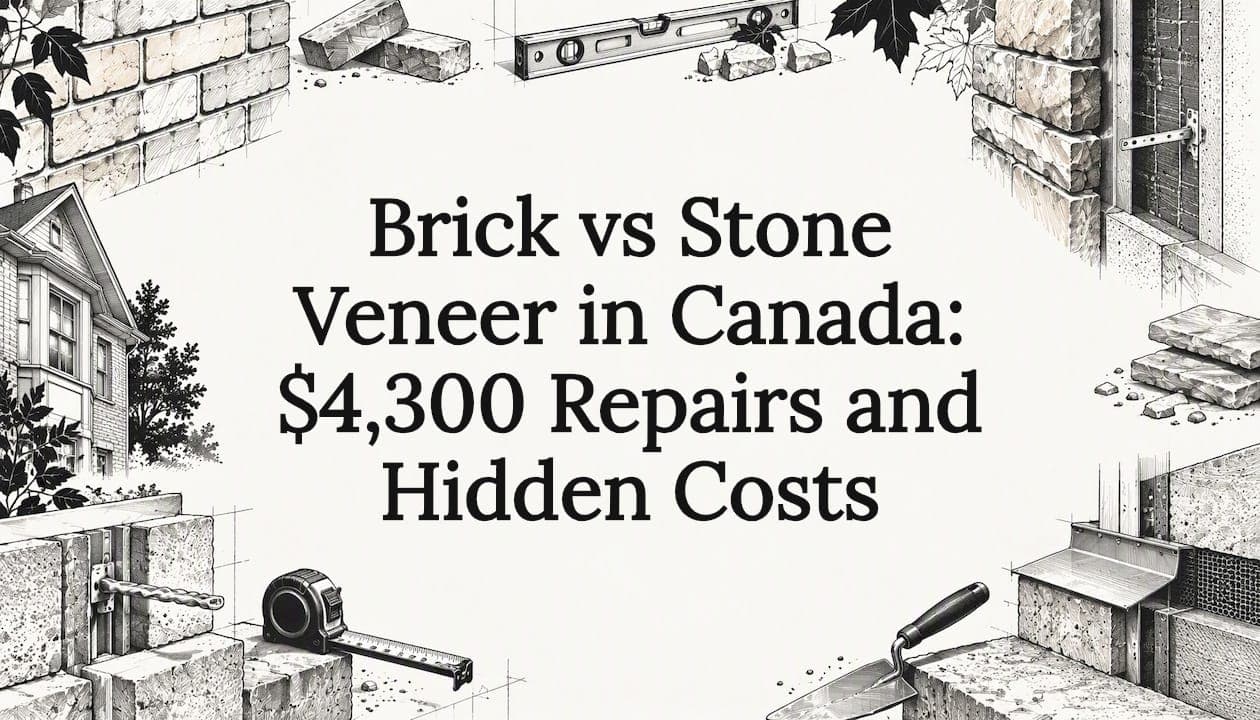
Choose brick veneer for long-lasting full façades, and manufactured stone veneer for textured focal areas and easier retrofits. Either one needs structural backing and at least a 25 mm air space behind it, plus flashing and weeps, and the CBAC technical guidance stresses the same details. How it is attached, anchored or adhered, drives both cost and structural needs.
TL;DR:
- Properly detailed masonry veneer has an approximate 50 year design service life; inspect flashing and weeps annually, repoint failing mortar, and avoid surface sealers.
- Some guidance prefers a 51 mm cavity, and ties should sit within 305 mm of control joints and openings; keep mortar droppings from blocking drainage.
- Compare itemized bids for substrate preparation, flashing, cavity cleaning, access, and hidden damage; headline price per square foot can conceal missing work.
- CBAC guidance cites 2026 repair costs around $4,300 in some Canadian markets for fallen stones or flashing and mesh repairs to stone veneer.
Table of Contents
- How do brick and stone veneer compare side by side?
- What does each material look like on a house?
- What will each option cost to install and repair?
- How long does veneer last and what upkeep does it need?
- What should you check in a bid for either system?
- Which veneer is right for your project?
- Why the wall behind the veneer matters more than the veneer
- How we help with veneer decisions on additions and renovations
- FAQ
- Sources
How do brick and stone veneer compare side by side?
- Look: brick gives regular courses and a consistent colour range. Stone gives irregular shapes, deeper texture and more variation from piece to piece.
- Cost: manufactured stone usually saves labour because it installs faster, while anchored brick means more trades and more cavity work. Natural stone sits at the high end for both material and labour.
- Durability: brick veneer is a long-lived cladding when its drainage is detailed properly. Both materials depend on the wall behind them.
- Maintenance: inspect flashing and weeps, repoint when mortar fails, and skip surface sealers.
- Installation: anchored brick is built on site course by course. Adhered stone goes on over prepared lath or panel fastenings.
- Weight: manufactured stone is much lighter than full-bed natural stone, which matters for structure.
Repair risk is real: a practitioner note in the CBAC guidance cites 2026 pricing of around $4,300 in some Canadian markets for stone veneer repairs such as re-setting fallen stones or fixing flashing and mesh. Getting the details right the first time is cheaper.
What does each material look like on a house?
Brick reads as orderly. Its courses, bonding patterns and long history on Canadian streets suit traditional, Georgian and Victorian-style homes, and it holds a clean line across a large wall.

Stone reads as rugged. Natural and manufactured stone both bring irregular shapes and shadow lines, and panelised products make that look easier to achieve. Some mortarless systems fasten through an embedded nailing strip and skip the lath and scratch coat, so a handy crew can move quickly.
A few pairing tips shape the final result:
- Match trim and window colours to the warmest or coolest tone in the veneer, not to the average.
- Let stone stop at a logical break, such as a corner, a porch base or a roofline, so it looks structural rather than pasted on.
- Choose mortar colour deliberately, since it changes how dark or light a brick wall reads from the street.
- If you plan to paint brick later, read this overview of brick painting pros and cons first, because paint is hard to undo.
What will each option cost to install and repair?
Quotes only compare fairly when you know what drives them. Manufactured stone often lowers installed cost because it is lighter, comes in a wide range of colours and textures, and usually installs faster with less structural reinforcement than full-bed natural stone. Adhered systems also deliver the masonry look at lower cost and with faster installation, as long as the substrate, drainage mat, fasteners and lath are done well.
Labour is where bids diverge, so ask each contractor to price these separately:
- Substrate prep, including sheathing, drainage mat and lath where the system calls for it.
- Flashing and transition work, which raises labour and also raises long-term risk if it is skimped.
- Cavity preparation and cleaning for anchored brick.
- Scaffolding, access and waste removal.
- A contingency line for hidden wall damage found once the old cladding comes off.
Pro Tip: Budget for proper flashing and cavity prep up front. It is one of the cheapest ways to avoid the water damage and repairs that make veneer expensive later.
How long does veneer last and what upkeep does it need?
Brick veneer is considered a durable cladding with a design service life of approximately 50 years when properly detailed with drainage components. Stone veneer follows the same logic: the wall assembly behind it decides how long it performs.
Detailing decides longevity: CBAC notes that masonry durability depends on high-quality envelope design, and that exterior sealants often trap moisture and can cause spalling.
That is the freeze-thaw story in short. Water that gets trapped behind or inside masonry expands as it freezes, and the face of the unit can flake off. Sealing the surface tends to hold moisture in rather than keep it out, which is why professionals generally advise against it.
Routine upkeep is modest:
- Look over flashing and weep holes each year, and keep them clear.
- Repoint mortar joints when they crumble or open up.
- Watch for stains, cracks and loose pieces after winter.
- Make sure the cavity was kept clean during construction, since you cannot fix that afterward without opening the wall.
What should you check in a bid for either system?
Veneer is nonstructural, so it has to be anchored to a backup and drained by a continuous air space with flashing and weeps. The same TEK guidance gives a minimum 25 mm gap, prefers 51 mm in some cases, and calls for ties placed within 305 mm of control joints and openings. For wood-frame walls, the Ontario rules require not less than a 25 mm air space, and the Part 9 masonry provisions set out unit thickness and tie requirements.
Anchored brick relies on wall ties and control joints. Adhered stone relies on its substrate, whether lath and a scratch coat or panel fastenings, so the prep differs. Two field problems cause most of the costly repairs: mortar droppings that bridge the cavity and block drainage, and improper flashing where an addition meets the existing house. A board in the cavity or beveled mortar beds helps with the first. The flashing details in the NCMA flashing guidance help with the second.
Ask your contractor to confirm these on the quote:
- What backing and sheathing the veneer is fastened to.
- The air space behind the veneer.
- Flashing at the base, openings and addition transitions, with weeps.
- Tie or anchor type and spacing, or the lath and fastener schedule for adhered stone.
- How the cavity will be kept clean during construction.
- Warranty terms and who handles a call-back.
Pro Tip: If a quote does not mention flashing and weeps at all, ask why before you sign.
Which veneer is right for your project?
Match the material to the job:
- Full exterior façade: brick veneer, where durability and a traditional look matter most.
- Accent walls, porch bases and entry features: manufactured stone veneer, for texture without much extra weight.
- Interior feature walls and fireplaces: manufactured stone, since it is lighter and faster to install.
- Retrofits on an existing home: manufactured stone in most cases, because it usually needs less structural reinforcement.
- Heavy natural stone or wide projections: bring in an engineer for a structural review first.
- Additions: put flashing at the new-to-old interface on the plan from day one.
If your project touches framing, see what to know before removing a load bearing wall, and check the permit and zoning basics for additions.
Why the wall behind the veneer matters more than the veneer
Most homeowners start with the face: red brick or grey stone. We think that is the wrong end of the wall to start. The material you see is a skin, and the skin only performs if the drainage, ties and flashing behind it are right. A beautiful veneer on a wet cavity can lead to costly problems over time.
In our work, the decisions that move outcomes are envelope details, a clearly written scope, and realistic budgeting and permitting when a veneer choice changes the structure or the timeline. Bring these questions to every contractor meeting: What is the substrate? How big is the air space and how is it flashed? What tie or anchor type is used? What does the warranty cover, and what maintenance do you expect from me?
Whichever bid answers those plainly is usually the one to trust. Any bid that changes the subject to price per square foot is telling you something too.
— Cory
How we help with veneer decisions on additions and renovations
When veneer is part of an addition or a full renovation, we handle it as part of one coordinated scope. That includes feasibility review, design coordination, permit handling and construction management, with material selection and detailing built in rather than bolted on.
- A site assessment of your walls and the planned transitions.
- Clear scope and budget before work starts.
- One accountable builder from design through completion.
Request a feasibility estimate through our full-home renovations page and we will walk the site with you.
FAQ
How long do stone veneers last?
It depends mostly on the wall assembly behind them, not the stone alone. Masonry veneer with proper drainage and detailing is designed for a long service life of around 50 years, and poor flashing is the most common reason it falls short.
Is veneer stone cheaper than brick?
Manufactured stone veneer often costs less to install because it is lighter and goes up faster. Natural stone usually costs more in material and labour, so compare itemized bids rather than headline prices.
How good is brick veneer?
Brick veneer is a durable cladding when it is built with structural backing, ties, an air space, flashing and weeps. Its performance rests on those details far more than on the brick itself.
What is masonry veneer construction?
Masonry veneer is a nonstructural outer layer of brick or stone that is anchored to a backup wall. A drained air space and flashing behind it are what let the wall shed moisture.